In today’s fast-paced hiring world, phone interviews are often the first hurdle job seekers must clear. Whether you’re applying for a customer service job, tech support, or a marketing role, how you sound and respond over a call can determine whether you proceed—or get screened out.
But here’s the truth: Most candidates don’t practice phone interviews. And even fewer get meaningful feedback before the real thing.
That’s where an AI Phone Interview Simulator comes in.
This cutting-edge tool uses Artificial Intelligence to simulate real-life phone interviews, providing:
Instant feedback on your voice tone, confidence, and speech clarity.
Job-specific questions based on your role or industry.
A safe space to practice and improve without judgment.
With the rise of remote work and virtual hiring, mastering phone and voice interviews is no longer optional—it’s a critical skill.
Whether you’re a student, a fresher, or a professional preparing for a promotion, an AI interview simulator gives you the edge you need to stand out.
Search-optimized keywords in this section:
AI phone interview practice
voice interview simulator
prepare for phone interview with AI
mock interview AI tool
7 Powerful Reasons You Should Use an AI Phone Simulator
Here’s a question you may be asking: Why use an AI tool to prepare for interviews when I can just Google some questions or ask a friend to help me out?
The difference is realism, feedback, and convenience.
Here are 7 powerful reasons why using an AI interview simulator is a game-changer:
Simulates Real-Time Phone Interviews You’re not just reading text or typing answers—you’re actually speaking into your phone or laptop, just like a real call with HR.
Unbiased, Instant Feedback AI doesn’t judge based on appearance or accents. It scores you on performance—objectively.
24/7 Access — Practice Anytime No scheduling. No appointments. Practice at 2 AM if you want.
Job-Specific Questions for Targeted Prep Whether you’re applying for a call center, tech job, or marketing role—get the questions that matter.
Boosts Your Confidence Over Calls The simulator tracks your tone, speed, and use of filler words like “uh”, “um”, and helps you reduce them over time.
Repetitive Practice Without Awkwardness Don’t feel like you’re “wasting” someone’s time by repeating the same practice session. AI is built for repetition.
Safe, Private, and Data-Secure No need to share your answers or voice recordings with anyone.
In short, an AI simulator is your personal mock interviewer—always ready, always honest, and always focused on helping you get better.
Search-optimized keywords in this section:
benefits of AI interview simulators
why use AI for interview preparation
mock phone interview AI
voice-based interview practice tools
How to Use an AI Phone Interview Simulator: A Beginner’s Step-by-Step Guide
Never used an AI tool for interviews before? Don’t worry—no tech skills are needed. Here’s how even a complete beginner can get started in just a few steps:
Step 1: Choose the Right Simulator
Find a reliable platform like VoiceGenie that offers:
Voice-based simulations (not just chat)
Real-time feedback
Industry-specific practice
Step 2: Create an Account (Takes 1 Minute)
Most platforms ask for your:
Name & email
Preferred job role or industry
Language or region (important for voice tone analysis)
Step 3: Select the Interview Type
Choose what kind of interview you want to simulate:
Entry-level job interview
BPO/Call Center simulation
Technical support round
HR screening call
Step 4: Start the Interview
The AI voice agent will start asking questions. You’ll need to:
Speak your answers clearly
Stay within a time limit (if set)
Treat it like a real HR call
Step 5: Review the Feedback
After each session, you’ll get a feedback report that includes:
Speech clarity
Use of filler words
Confidence and tone
Suggested improvements
🌟 Pro Tip: Use a headset and find a quiet room for best results. Repeat the session as many times as needed.
Realistic Interview Scenarios for Different Industries
Not all interviews are the same. The way a customer service representative is interviewed is very different from how a sales executive or a tech support candidate is assessed.
That’s why the best AI phone interview simulators—like VoiceGenie—let you choose from role-specific scenarios.
Here are examples of industry-specific simulations you should look for:
Customer Support or BPO Roles
Handling angry customers
Common call center QA questions
Tests your patience, tone, and empathy
Technical Support
Troubleshooting questions
Product knowledge
Ability to explain technical terms in simple language
Sales & Telemarketing
Cold call simulations
Objection handling
Persuasive communication and call-to-action delivery
Administrative or HR Roles
Scheduling, coordination, multitasking ability
HR knowledge-based questions
Polite, composed communication style
The AI dynamically adjusts based on your responses, mimicking how a real HR interviewer might probe further. It’s not just a Q&A — it’s an interactive conversation.
The more realistic your practice, the more confident you’ll be when the actual call happens.
Get Actionable Feedback That Helps You Actually Improve
Practicing interview questions is good. But getting the right feedback is what turns practice into progress.
Modern AI interview tools don’t just tell you whether your answer was correct—they analyze how you speak, and more importantly, how you come across to the person listening on the other side.
Here’s what a good AI feedback report should include:
Speech Clarity
Was your voice too soft or too loud?
Did you speak too fast or too slow?
Pace & Pauses
Did you pause at the right time?
Were your answers rushed or too long?
Tone & Confidence
Did you sound confident and clear?
Were you monotone, nervous, or overly casual?
Keyword Usage
Did you use job-related keywords?
Were your answers aligned with the job role?
Filler Words Detection
Words like “uh,” “umm,” “like,” “you know” are tracked.
Suggestions to reduce overuse and improve sentence flow.
And here’s the best part: with tools like VoiceGenie, the feedback isn’t just technical. It’s human-like and personalized, so you feel like a coach is guiding you after each call.
“You spoke confidently, but your closing statement lacked impact. Try summarizing your strengths in the final 10 seconds.” — Example of VoiceGenie’s smart suggestion.
How Repeated Practice Turns You Into a Confident Interviewee
You don’t become great at interviews by reading tips once. Like any skill, confidence in phone interviews comes with repetition, coaching, and correction.
Here’s how daily use of an AI phone interview simulator can elevate your career readiness:
Daily Practice Builds Habit
A 10-minute session every day conditions your brain for real-time response.
Just like going to the gym, consistency beats intensity.
Unlimited Mock Sessions
Repeat as many times as you like.
Each session brings new questions or rephrases old ones for variety.
Identify and Fix Weak Spots
You’ll clearly see where you struggle:
First impressions
Technical answers
Ending the call on a strong note
Personalized Coaching Tips
Good simulators like VoiceGenie act like a digital mentor.
You’re not just hearing “You’re wrong”—you’re being told why and how to fix it.
Over 80% of candidates say they feel more confident after just 3 days of using AI-based mock interview tools.
How AI Voice Agents Help You Crack the Interview?
When preparing for interviews, practicing questions is only half the battle. The way you speak, respond, and manage pressure matters just as much. That’s where VoiceGenie, your AI-powered voice coach, stands out.
VoiceGenie isn’t just a simulator—it’s a realistic AI voice agent that trains you like a professional.
Real-Time Voice Conversations
Unlike chat-based tools, VoiceGenie interacts with you over real voice calls—just like a recruiter would. You hear questions and respond in real-time, not by typing. This helps you practice:
Listening comprehension
Quick, structured verbal responses
Real conversation flow under pressure
Smart Probing Just Like HR
VoiceGenie doesn’t stop at one question. Based on your answers, it asks follow-up questions—mimicking how a real recruiter probes deeper. This trains you to think on your feet.
“Can you give an example of when you handled an angry customer?” Follow-up: “How did you resolve it without escalating?”
Adaptive Coaching Engine
VoiceGenie analyses:
Your vocal tone
Confidence level
Language clarity
Speech speed & filler word usage
Then it gives customized feedback, not generic suggestions.
“Try using power verbs like resolved, managed, improved. Your tone dipped when discussing conflict—try to stay neutral yet confident.”
Role-Specific Interview Templates
Whether you’re preparing for:
BPO interviews
Customer service roles
Tech support jobs
Sales/Telecalling VoiceGenie has pre-built simulations that mirror actual company assessments.
Trusted by Professionals & Career Coaches
VoiceGenie is not just a tool for freshers. Career coaches, HRs, and recruitment agencies use it to prep clients for competitive interviews, including in high-pressure industries.
💡 If you want to feel “ready for anything” in your next phone interview, VoiceGenie is the shortcut you’ve been looking for.
Voice Modulation & Communication Skills Training
Train Your Voice to Sound More Confident and Professional
Most candidates don’t get rejected because of what they say—but how they say it. Poor voice tone, too many filler words, or unsteady pacing can hurt your impression, even if your answers are good.
An AI voice simulator helps you fix these subtle but critical mistakes.
Learn Voice Modulation
VoiceGenie helps you master how to:
Emphasize key words.
Avoid flat/monotone responses.
Sound persuasive in sales interviews.
Maintain neutrality in conflict-related answers.
⏱️ Control Pace & Eliminate Fillers
The tool tracks how often you say:
“uh”, “umm”, “you know”, “like”
It shows when you’re talking too fast or dragging answers. Over time, you naturally:
Speak clearly under pressure.
Organize thoughts better before answering.
Reduce unnecessary pauses.
🤖 Real-Time Audio Feedback Loop
After each session, you receive:
A visual score for tone, pacing, fluency.
Graphs showing improvement over time.
Suggested vocal exercises to improve speech control.
🎯 “Your pace was 160 words per minute — aim for 120–140 for clarity.”
This kind of feedback is impossible with static question banks or text-only prep apps.
Progress Dashboard & Goal Tracking
Track Your Progress Like a Pro — Visualize Your Growth
Seeing your improvement motivates you to stay consistent. That’s why the best AI phone interview simulators offer dashboards and goal tracking tools.
Performance Analytics You Can Understand
VoiceGenie’s dashboard shows:
Daily practice sessions
Score trends (confidence, clarity, vocabulary)
Your top 3 improvement areas
Filler word frequency over time
🎯 Personalized Goals
Set clear goals like:
“Improve tone modulation in 5 days”
“Reduce filler words to under 2 per minute”
“Crack mock BPO interview by Sunday”
You’ll get nudges, reminders, and progress milestones as you improve.
In today’s competitive job market, preparing for interviews is no longer just about memorizing common questions or reading company websites. Employers are increasingly focusing on communication style, problem-solving ability, and confidence under pressure.
This is where an AI interview copilot comes into play — a new-age solution that merges artificial intelligence, language processing, and real-time conversational feedback to help candidates practice and perfect their interview skills. Many job seekers today are actively looking for an AI interview copilot free or a free AI interview copilot to practice without paying for expensive coaching upfront.
What is an AI Copilot for Interviews?
An interview copilot (also referred to as an interview co pilot) is a virtual assistant powered by advanced AI models that simulates real job interviews. Unlike static mock interviews, the best interview AI copilot behaves like a real interviewer — adapting questions, reacting to your responses, and giving structured feedback instantly.
Modern copilots often leverage the same real-time voice AI technology used in enterprise systems like real-time voice AI agents to make conversations feel natural and pressure-ready.
These tools can:
Ask interview questions tailored to your role or resume
Analyze your responses in real time (tone, word choice, clarity)
Score your performance based on industry benchmarks
Suggest improvements using behavioral and linguistic insights
Think of it as a 24/7 AI interview copilot free from human bias, acting as a personal interview coach — sometimes even speaking to you through voice, similar to how AI voice agents conduct real conversations.eo.
Examples of What It Can Do:
A well-designed AI interview copilot can:
Simulate behavioral interviews using STAR method analysis
Assess your voice tone, pace, and filler words like “uhh” or “umm”
Ask smart follow-up questions based on your previous answer
Provide feedback such as:
“Your answer lacked structure”
“Avoid passive language while explaining achievements”
Whether you’re a fresher preparing for campus placements or a senior professional targeting leadership roles, an AI interview copilot for technical interviews or behavioral rounds helps close the gap between knowledge and confident delivery.
Why You Need an AI Copilot for Interview Prep
Let’s be honest — traditional interview preparation is outdated. Reading blog lists or watching random YouTube videos doesn’t prepare you for real-time pressure. That’s why candidates increasingly prefer free AI mock interview practice tools that simulate real scenarios.
An AI interview copilot free option allows repeated practice without judgment — the same way enterprises use testing a real AI voice call (human-like demo) before deploying voice agents at scale.
The Common Struggles Candidates Face:
Stage fear or anxiety during real interviews
Inability to think on your feet when asked unexpected questions
Struggling to structure answers for behavioral or situational questions
Poor communication due to filler words, stammering, or accent issues
Lack of feedback when practicing alone
Not knowing how to improve after each mock session.
This is where even affordable AI interview copilot solutions for staffing agencies and job portals are gaining traction — because structured feedback improves outcomes faster.
What Makes AI Copilots a Game-Changer?
1. Real-Time Feedback
An AI interview copilot doesn’t just listen — it analyzes. You get instant insights such as:
“You spoke too fast”
“Your answer lacked clarity”
“This phrase sounded unprofessional”
This mirrors how voice AI analytics are used in real customer conversations.
2. Personalization Based on Role/Resume
Modern AI tools can tailor mock questions based on your:
Uploaded resume
Target industry
Years of experience
This is why enterprises evaluating AI interview copilot for large corporations – features comparison prioritize personalization and accuracy — especially for leadership and technical roles.
3. Behavioral and Technical Interview Support
The most accurate AI interview copilot for technical interviews can simulate:
HR and behavioral rounds
Role-specific technical interviews
Leadership and decision-making scenarios
Some even offer real-time recruiter-style prompts, answering the question: which AI interview copilot offers real-time recruiter prompts?
4. Affordable and Always Available
Unlike paid mentors, an AI interview copilot free or low-cost solution is always accessible — even minutes before your interview. This is similar to how businesses rely on AI voice for business automation instead of manual calling.
5. Voice and Tone Training
Practice like it’s a real call—with AI analyzing:
Confidence in your tone
Hesitations
Pronunciation clarity
Accent adaptability (especially important for global jobs)
Unlike friends or mock interviewers who may hesitate to give tough feedback, AI is brutally honest:
“You repeated the word ‘team’ 7 times in 2 mins”
“Avoid buzzwords like ‘synergy’ without context”
This helps eliminate weak spots you may not even be aware of.
📊 AI Copilot vs Traditional Preparation
Feature
AI Interview Copilot
Traditional Method
Personalized Feedback
✅ Yes
❌ Rare
Real-Time Simulation
✅ Yes
❌ Mostly Theory
Voice/Body Language Training
✅ Yes
❌ No
Available 24/7
✅ Yes
❌ No
Industry-Specific Questions
✅ Yes
❌ Generalized
Who Should Use AI Interview Copilots?
An AI interview copilot isn’t just for techies or candidates applying for elite roles. Today, people across industries actively search for a free AI interview copilot or AI interview copilot free to improve confidence, structure, and real-time communication before high-stakes interviews.
Whether you’re a student, a working professional, or someone returning to the workforce, the best interview AI copilot adapts to your background, experience level, and interview goals — much like how AI voice agents adapt conversations based on user context.
Let’s explore who benefits the most from using these intelligent tools:
1. Students & Fresh Graduates (Zero Experience)
Freshers are among the highest users of free AI mock interview practice tools, especially for campus placements.
Common Struggles
Nervousness during campus interviews
No real-world interview exposure
Unstructured answers to basic HR questions
How an AI Interview Copilot Helps
Simulates real campus interviews with realistic pressure
Gives feedback on tone, clarity, and confidence
Builds structured answers using STAR or PREP frameworks
Example use case: A final-year engineering student uses an AI interview copilot free tool to practice HR rounds. The AI suggests changing:
“I think I’m a quick learner” to “During my internship, I learned Python in 3 weeks and built a working project.”
2. Job Switchers / Working Professionals (1–10 Years Exp.)
Professionals switching roles often search for an AI interview copilot for experienced professionals to regain interview confidence after years of not interviewing.
Common Struggles
Adjusting to new domains or industries
Behavioral rounds focused on leadership and ownership
Difficulty quantifying past impact
How AI Helps
Generates domain-specific interview questions
Flags weak storytelling and missing metrics
Provides structured feedback for leadership scenarios
Acts like a recruiter giving real-time prompts
This is similar to how AI call analytics highlight gaps in real sales or support conversations.
Example use case: A project manager practicing with an AI interview copilot gets feedback:
“Your answer explains responsibilities well, but lacks measurable outcomes.”
3. International Job Seekers / Remote Candidates
For global roles, candidates often look for the most accurate AI interview copilot to improve communication clarity rather than content alone.
Example use case: An Indian developer applying to U.S. companies replaces:
“I am having experience in…” with “I have 4 years of experience in…”
4. Tech Professionals (Coding, Data, Product, IT)
Tech professionals increasingly search for the most accurate AI interview copilot for technical interviews — especially for system design and problem-solving rounds.
Example use case: A backend engineer explains a payment system design. The AI interview copilot flags vague phrases like “kind of scalable” and suggests clearer technical articulation.
5. Non-Tech Roles (HR, Sales, Support, Admin)
Non-tech candidates often underestimate interviews and later search for a best interview AI copilot that focuses on storytelling, persuasion, and soft skills.
Common Struggles
Inability to quantify achievements
Weak storytelling
HR round anxiety
How AI Helps
Converts responsibilities into impact-driven answers
Example use case: A sales executive receives feedback:
“You mentioned targets, but not results — add numbers like ‘exceeded quota by 30%.’”
Summary Table: Who Should Use AI Copilots?
User Type
Common Challenges
How AI Copilot Helps
Students & Freshers
Nervousness, lack of structure
Simulated HR rounds, STAR guidance
Job Switchers
Storytelling, domain shift
Behavioral scoring, role-specific questions
Global Candidates
Fluency, accent, phrasing
Pronunciation analysis, cultural phrasing
Tech Professionals
Clarity, pressure handling
System design evaluation, coding voice prep
Non-Tech Roles
Justifying soft skills
Achievement framing, tone coaching
Core Features to Look for in an AI Interview Copilot
With dozens of tools claiming to be the best interview AI copilot, not all solutions deliver the same depth. Some only offer text-based Q&A, while others provide real-time voice analytics, recruiter-style prompts, and behavior mapping.
Whether you’re evaluating a free AI interview copilot for practice or comparing AI interview copilot for large corporations – features comparison, every effective tool should include the following core capabilities.
1. Real-Time Voice-Based Interview Simulation
A high-quality AI interview copilot should simulate a live interviewer through real-time voice conversations, not just typed responses.
Why it matters:
Replicates real interview pressure
Trains tone, pacing, and clarity
Builds confidence through repetition
This capability is powered by the same infrastructure used in real-time voice AI agents deployed by enterprises for real customer conversations.
✅ Look for: An AI that asks questions via voice, listens actively, and responds with instant feedback — a key differentiator when evaluating which AI interview copilot offers real-time recruiter prompts.ack.
2. AI-Generated Feedback & Performance Scoring
The most accurate AI interview copilot doesn’t just record your answers — it analyzes them deeply.
This level of customization is essential when assessing affordable AI interview copilot solutions for staffing agencies, where candidates come from diverse backgrounds.
4. STAR/Behavioral Training Mode
For behavioral-heavy interviews, an interview copilot must actively train you in structured storytelling.
The AI should coach answers using:
Situation
Task
Action
Result
You’ll receive feedback such as:
“You explained the situation well, but missed the measurable outcome.”
Advanced AI interview copilots allow resume uploads and generate questions based on:
Your previous roles
Achievements and metrics
Keywords recruiters focus on
This feature directly supports most accurate AI interview copilot for technical interviews, as questions align with how interviewers actually evaluate resumes.
Best AI Interview Copilot Tools in 2025 (Comparison Guide)
Now that you know what to look for, let’s compare the top AI interview copilots on the market. This comparison helps users make informed choices based on their level, goals, and industry.
Tool
Best For
Pricing
Key Features
Voice-Based?
VoiceGenie
Voice + Behavioral Interviews
Freemium
Real-time voice, STAR feedback, resume analysis
✅
Google Interview Warmup
Beginners, freshers
Free
Text-based Q&A, keyword highlighting
❌
Huru.ai
Fast feedback
Free + Paid
Performance scorecard, question bank
✅
PrepAI
Structured learning
Paid
Custom scenarios, performance tracking
❌
VMock
Resume + Interview coaching
Enterprise/University access
AI resume grading, soft skill coaching
❌
Step-by-Step: How to Use an AI Interview Copilot Effectively
Simply signing up for an AI interview copilot free tool won’t automatically improve interview performance. To get real results, you must use it like a coach — not just a simulator. The best interview AI copilot delivers value only when used consistently and strategically.
Here’s a proven workflow used by candidates — and even enterprises evaluating AI interview copilot for large corporations – features comparison.
Step-by-Step Workflow:
Step 1: Choose the Right AI Copilot
Identify your target role (e.g., Sales Manager, Software Engineer)
Decide if you need voice simulation or just Q&A
Pick a tool based on your level (beginner vs pro)
✅ Recommendation: Start with one mock tool and stick with it for 2–3 weeks.
Step 2: Upload Resume / Select Job Role
Let the AI pull relevant achievements or work experiences
Get tailored interview questions based on what you’ve done
🧠 Pro Tip: Clean your resume before uploading to avoid generic suggestions.
Step 3: Start Mock Interviews
Choose the right difficulty:
Beginner
Intermediate
Expert
Then begin speaking naturally — just like a real interview.
Avoid memorized scripts. AI interview copilots trained on voice analytics (similar to real-time ASR pipelines) can detect unnatural flow instantly.
This is where free AI mock interview practice becomes far more effective than reading answers.
Step 4: Analyze the Feedback
After each session, review insights across three dimensions:
Structure
Did you follow STAR, PREP, or logic-based formats?
Tone
Did you sound confident, hesitant, rushed, or passive?
Clarity
Was your answer easy to follow and outcome-focused?
Focus on one weakness weekly (e.g., clarity, confidence, metrics)
Gradually increase interview difficulty
🎯 Goal: By week three, most users see a 20–30% improvement in fluency, structure, or confidence — especially when using a free AI interview copilot consistently.
Best Practices:
Use headphones for clear audio analysis
Record sessions for self-review
Practice at the same time of day as your real interview
Industry-Specific Use Cases: How AI Copilots Adapt to Different Interview Types
One major advantage of modern AI interview copilots is adaptability. The questions, tone, and evaluation criteria change based on industry — just like how enterprise voice AI platforms customize conversations by role.
Below, we explore how AI interview copilots cater to specific industries—and how you can maximize them for your unique role.
1. Technology & Engineering Roles
Common Interview Formats:
Behavioral + System Design rounds
Whiteboard coding or algorithm questions
“Tell me how you’d build…” questions
AI Copilot Capabilities:
Simulates tech rounds using job-specific prompts
Offers voice-based explanations of code logic or architecture
Evaluates use of technical jargon, confidence, and logical flow
Use Case Example: A backend engineer practices payment system design. The AI probes latency, database, and scalability — similar to how AI for BFSI systems are evaluated.
2. Sales, Marketing & Customer-Facing Roles
Common Interview Focus:
Communication, persuasion, objection handling
Storytelling with measurable impact (KPIs)
Situational behavior during stress/conflict
AI Copilot Capabilities:
Simulates roleplay-style interviews (e.g., “Sell me this product”)
“You mentioned ‘I helped boost sales’—be specific. Try: ‘I increased Q4 sales by 18% through upselling.’”
Use Case Example: A digital marketing manager uses AI to prepare for interviews in a fast-paced startup, refining their ability to convey marketing results under time pressure.
Use Case Example: A nurse practitioner practices soft-skill based questions. The AI recommends improving phrasing when explaining complex medical terms.
4. Law, Policy & Government
Interview Style:
Analytical thinking
Case-based discussions
Decision making in gray areas
AI Capabilities:
Presents legal/ethical case studies
Assesses clarity and neutrality in responses
Detects overuse of jargon or political correctness
Offers phrasing tips:
“Avoid vague words like ‘probably.’ Be assertive in structured decisions.”
Example Use Case: A public policy graduate prepares for a UN internship. The AI simulates a UN-style behavioral interview and scores their response structure and diplomatic tone.
5. MBA, Product Management & Leadership Roles
Interview Structure:
Case studies
Strategy questions
Cross-functional scenarios
AI Copilot Features:
Simulates McKinsey-style or product scenario interviews
Analyzes strategic thinking, clarity, and leadership framing
Scores logic flow, prioritization, and stakeholder sensitivity
Use Case: A mid-level professional switching to product management uses VoiceGenie to simulate a “Launch strategy for a fitness app” interview. AI flags lack of stakeholder awareness and recommends reframing.
Summary Table: Industry Use Case Comparison
Industry
AI Special Features
Question Focus
AI Feedback Areas
Tech & Dev
System design, code logic
Problem-solving
Clarity, terminology
Sales/Marketing
Roleplay, persuasion tone
KPIs, objection handling
Voice tone, metrics
Healthcare
Ethics, patient scenarios
Empathy, clarity
Simplicity, trust
Legal/Policy
Analytical cases
Decision-making
Assertiveness, neutrality
MBA/Product
Strategy, case methods
Prioritization
Structure, leadership tone
Real User Stories & Testimonials (Case Studies)
While features and technology are impressive, what truly convinces people is real-world success. In this section, we’ll share authentic use cases of candidates who used AI interview copilots to overcome obstacles, improve performance, and land job offers.
These stories not only showcase the value of AI tools but also help potential users relate to their own situations—whether they’re students, career switchers, or international applicants.
Case Study 1: Riya – Final Year Student, Preparing for Campus Interviews
“I had no idea how to answer behavioral questions without sounding robotic. I used VoiceGenie for two weeks and practiced 10 mock interviews. It gave me real-time feedback on my voice tone and how many times I was saying ‘uhh’ or ‘like.’ Within days, I was speaking more confidently. I cracked my first campus interview with a product company and even got complimented on my communication.”
Challenge:
Low confidence
Overuse of filler words
Unstructured answers
AI Helped With: ✅ Tone monitoring ✅ STAR method structuring ✅ Confidence building through repetition
Outcome:
Got placed through campus recruitment
Improved fluency and reduced nervousness
Case Study 2: Ankit – 3-Year Experienced Developer Switching to Product Role
“I had never been in a PM-style interview before. The AI copilot simulated a product design scenario and gave feedback like ‘You skipped user personas’ and ‘No metrics mentioned.’ I kept refining my answers using the tips it gave. In 3 weeks, I was ready for the real deal—and I got shortlisted for two PM roles.”
Challenge:
Lacked exposure to strategy-style questions
Struggled to quantify product decisions
AI Helped With: ✅ Role-specific practice ✅ Feedback on logic and prioritization ✅ Suggesting metric-driven responses
Outcome:
Landed multiple PM interviews
Felt prepared to speak business language, not just tech
Limitations & What Not to Expect
While AI interview copilots are incredibly useful, they are not magic wands. Like any tool, they come with their own limitations. Understanding these will help users use the tool realistically and effectively—not over-rely on it.
What AI Interview Copilots Cannot Do
1. They Can’t Predict Company-Specific Questions
AI copilots are trained on patterns and datasets, but they can’t access real-time interview data from companies like Google, Meta, or McKinsey.
Expect preparation, not prediction.
2. They Don’t Understand Deep Emotions or Contexts
AI can analyze tone, grammar, and fluency, but it doesn’t understand your life experiences like a human coach or mentor would.
A story that feels powerful to you may be flagged as too long by AI—use your judgment.
3. They Might Misinterpret Accents or Cultural Nuance
Accent or phrasing feedback might occasionally be off for certain regions. Always test the tool’s bias—some may favor American or British English standards.
4. Data Privacy Isn’t Always Guaranteed
If you’re uploading resumes or voice responses, always check:
Does the platform store your recordings?
Can your data be used for training their model?
Is the platform GDPR or CCPA compliant?
Use tools that clearly mention privacy and encryption policies.
5. They Don’t Replace Human Mentorship
AI copilots can help optimize your responses—but they can’t coach you on how to negotiate salary, read body language, or handle emotional questions in tough interviews.
Final Verdict: Which AI Copilot is Right for You?
Choosing the best AI interview copilot isn’t about picking the most advanced tool. It’s about finding the right fit for your interview stage, comfort level, and target industry.
Frequently Asked Questions (FAQs)
Use this section for SEO-rich FAQs that capture voice, featured snippet, and long-tail traffic. Consider implementing FAQ Schema for better Google visibility.
What is an AI Interview Copilot?
It’s a tool that simulates job interviews using artificial intelligence. It asks you questions, analyzes your answers, and gives feedback on your voice, content, and tone.
Is AI really effective for interview preparation?
Yes, if used correctly. AI copilots help practice under pressure, provide unbiased feedback, and offer improvement metrics. However, they work best when combined with personal coaching or self-reflection.
Are there any free AI mock interview tools?
Yes. Tools like Google Interview Warmup and Huru (basic plan) offer free access. Some platforms also offer trial interviews or free credits.
Can AI understand my accent or non-native English?
Some tools like VoiceGenie and Huru are designed to handle multiple accents and provide neutral-English corrections. But not all tools do—always test before relying on them.
Is my data safe with these AI platforms?
Check each platform’s privacy policy. Choose ones that follow GDPR/CCPA, don’t store recordings without consent, and allow deletion of your data.
How often should I practice with an AI copilot?
2–3 sessions per week is a good start. Track your performance and focus on weaker areas.
Imagine calling a company and getting stuck in a long menu that says, “Press 1 for this, press 2 for that…” It’s slow, frustrating, and feels like no one is really listening. That’s how traditional IVR systems work.
Now, imagine calling the same company and just saying, “I want to know my order status,” and instantly getting a human-like voice replying with your order info. That’s what AI voice agents do.
This guide will help you understand:
What IVR is,
How AI voice agents are different and better,
And how businesses can upgrade to AI without confusion.
Whether you’re new to the concept or already using voice systems, this guide will take you step by step—from basics to expert level of IVR to ai voice agents.
What is IVR (Interactive Voice Response)?
IVR stands for Interactive Voice Response. It’s a system that allows people to interact with a phone menu using their voice or keypad.
You’ve likely used it when calling your bank, mobile company, or airline. For example:
“Press 1 to check your balance. Press 2 to talk to a customer care executive.”
IVR works by giving pre-recorded options. You choose one by pressing numbers or saying simple words. Then the system plays a response or connects you to an agent.
Pros of IVR:
Works 24/7
Saves cost by reducing live agents
Useful for basic info (like balance check)
Cons of IVR:
Feels robotic and outdated
Long menus waste time
Cannot understand complex or natural questions
Often ends up connecting to an agent anyway
In short, IVR was good when it came out—but in today’s fast world, customers want faster, smarter help.
Limitations of Traditional IVR
Traditional IVR systems were useful in the early days of automation. But now, they cause more frustration than help. Let’s understand why.
1. Too Many Menu Options
Customers often hear a long list like:
“Press 1 for billing, press 2 for technical support, press 3 to speak to an agent…”
By the time they reach the right option, they’ve either forgotten what to press or just want to hang up.
2. No Natural Conversation
IVRs cannot understand full sentences. You can’t just say,
“I need help with my refund from last week.” Instead, you must stick to their script. This makes the experience feel robotic.
3. Poor User Experience
Most IVRs don’t understand emotion, urgency, or context. If a customer calls during an emergency (like a blocked credit card), they still have to go through the same boring process.
4. High Drop-Off Rates
Many people hang up midway because they feel stuck or unheard. This hurts customer satisfaction and makes businesses look outdated.
4. Introduction to AI Voice Agents
AI Voice Agents are smart, human-like virtual assistants that speak and understand just like people do. They are powered by Artificial Intelligence (AI) and Natural Language Processing (NLP).
You don’t need to press any buttons. You just speak, and the voice agent listens, understands, and responds in real time.
Example:
You say:
“I want to check my last payment.” The AI voice agent replies: “Sure! Your last payment was ₹3,400 on July 5th. Would you like to hear more details?”
It’s that simple and smooth.
How it Works (In Simple Words):
You speak →
It converts speech to text →
The AI understands your intent →
It gives a response →
Then turns it back into speech
All this happens within seconds—faster than IVR and without the need for button-pressing.
IVR vs AI Voice Agents: A Detailed Comparison
As customer expectations grow, the need for faster and smarter phone-based support becomes essential. Both IVR and AI voice agents are designed to handle customer calls, but they work very differently. Let’s break down the differences so you can understand why many businesses are moving from IVR to AI.
1. Interaction Style
IVR: Uses touch-tone menus. You must press numbers to navigate through options. Example: “Press 1 for account info, press 2 for billing…”
AI Voice Agent: Lets you speak naturally—like talking to a real person. Example: You say, “I want to know my bill amount,” and the AI instantly responds.
✔️ Why it matters: AI removes the stress of remembering numbers or getting stuck in menus. It feels human.
2. Speed & Efficiency
IVR: Slow and linear. You must follow a fixed path step-by-step. If you make a mistake or press the wrong key, you start over.
AI Voice Agent: Instantly understands your request, no matter how it’s said. You jump straight to the solution.
✔️ Why it matters: Customers save time. No more “menu hopping.”
3. Understanding Language
IVR: Only recognizes basic voice commands or keypad inputs. It cannot understand full sentences or context.
AI Voice Agent: Uses Natural Language Processing (NLP) to understand complete sentences, intent, and even some emotions. Example: Say “I need to reschedule my appointment from tomorrow to Friday.” → An AI voice agent understands it completely. → An IVR would not know what to do with that sentence.
4. Personalization
IVR: Treats every caller the same. It does not know who is calling or why.
AI Voice Agent: Can recognize returning customers, access past conversations, and provide personalized responses.
“Hi Sara, I see you called yesterday about a refund. Do you want to continue where we left off?”
✔️ Why it matters: Personalization builds trust and improves customer experience.
5. Learning & Improvement
IVR: Cannot learn. It’s static and requires manual updates.
AI Voice Agent: Continuously learns from past conversations, improves accuracy, and even adapts responses based on user behavior.
✔️ Why it matters: AI gets smarter with time—IVR doesn’t.
6. Customer Experience
IVR: Often feels cold, robotic, and frustrating. Many customers hang up or ask for a human.
AI Voice Agent: Feels more like talking to a smart assistant. It’s conversational, helpful, and available 24/7.
Summary Table
Feature
Traditional IVR
AI Voice Agent
Interaction Style
Press keys or basic voice
Speak freely and naturally
Speed
Slow, step-by-step
Fast and direct
Language Understanding
Limited to basic commands
Full sentence & intent aware
Personalization
None
High
Learns Over Time
No
Yes
Customer Satisfaction
Low
High
How AI Voice Agents Work (Non-technical Explanation)
You don’t need to be a tech expert to understand how AI voice agents function. Let’s walk through the process in a way that’s simple for everyone.
Step-by-Step: What Happens When You Call?
When a customer calls and speaks to an AI voice agent, here’s what happens behind the scenes:
✅ 1. You Speak Normally
You say something like:
“I want to reschedule my doctor’s appointment to Monday.”
✅ 2. Speech is Converted to Text
The AI uses something called Speech-to-Text (STT) to convert your voice into words the system can read.
✅ 3. AI Understands What You Mean
Now comes the smart part: It uses Natural Language Processing (NLP) to understand your intent — in this case, “reschedule appointment” — and the details: “to Monday.”
✅ 4. It Finds the Right Response
The AI checks the database or your account, sees available slots, and prepares a suitable reply.
✅ 5. It Speaks Back to You
Using Text-to-Speech (TTS), it turns the response into a natural-sounding voice:
“Sure! Your appointment has been rescheduled to Monday at 10 AM.”
Why This Feels Like Magic to the Customer
It’s fast.
It’s smooth.
And it feels like you’re talking to a very smart assistant — not a robot.
Unlike IVRs, AI voice agents don’t need you to repeat yourself, and they can handle complex requests without pressing any buttons.
7. Real-World Use Cases of AI Voice Agents
AI voice agents aren’t just for big tech companies. They’re now helping businesses across different industries. Let’s explore how.
1. Healthcare
Appointment bookings and reminders
Lab report updates
24/7 emergency call routing
Example: “I need to book a dental checkup this Friday.” → The AI checks available slots and books it instantly.
2. E-Commerce
Order tracking
Returns and refunds
Product recommendations
Example: “Where is my last order?” → AI pulls the tracking info and gives real-time delivery updates.
3. Banking & Finance
Balance inquiry
Transaction alerts
Fraud detection & reporting
“I noticed an unknown transaction yesterday.” → AI can freeze the card or transfer you to the fraud team in seconds.
4. Home Services & Utilities
Service appointment scheduling
Bill reminders
Emergency service dispatch
“My AC has stopped working!” → AI sends a technician or connects to emergency dispatch right away.
5. Travel & Hospitality
Booking and check-in
Flight status updates
Handling cancellations or delays
“Can I change my hotel reservation from the 15th to 17th?” → AI checks availability and confirms your new dates.
Why These Use Cases Matter
AI voice agents save time for customers and reduce workload for support teams. They’re fast, consistent, and available 24/7 — something even human agents can’t always offer.
Benefits of AI Voice Agents Over IVR
Switching from IVR to AI voice agents isn’t just a tech upgrade — it’s a business advantage. Here’s why companies are making the switch.
1. Faster Response Times
AI understands natural language instantly. Customers get to the point faster without wasting time in long menus.
2. Human-Like Conversations
AI voice agents can listen, think, and speak like humans. They don’t sound like a robot — they listen with meaning, not just words.
3. Multilingual Support
AI agents can speak in many languages, allowing you to serve a wider audience without hiring a multilingual team.
Example: A voice agent can speak Hindi, English, Spanish, or even regional languages fluently.
4. Intelligent Routing
If the AI cannot solve the issue, it can smartly transfer the call to a live agent—along with context—so customers don’t need to repeat themselves.
5. Increased Agent Productivity
By handling routine queries, AI frees up your human agents to focus on more complex or emotional conversations, improving overall efficiency.
6. Lower Operational Costs
No need to hire and train large teams. AI voice agents can handle thousands of calls at once, reducing your support costs by up to 60–70%.
7. Improved Customer Experience
Customers feel heard and helped quickly. No more wait times. No more robotic voices. Just fast, friendly support.
Business Impact in Summary:
Benefit
Traditional IVR
AI Voice Agent
Call Handling Speed
Slow
Fast & intelligent
Customer Satisfaction
Low
High
Language Support
Limited
Multilingual
Cost
Medium to High
Lower long-term
24/7 Availability
Yes, but limited
Yes, with smart logic
How to Transition from IVR to AI Voice Agent
Switching from IVR to AI voice agents may sound technical—but it doesn’t have to be. With the right steps and guidance, any business can upgrade its call system without disruption.
This section will walk you through a step-by-step roadmap: from evaluating your current IVR to fully implementing AI voice agents like VoiceGenie.
Step 1: Evaluate Your Current IVR System
Start by understanding where your current IVR stands. Ask these questions:
What type of calls does your IVR handle today?
Where are customers dropping off?
How long do calls take on average?
Are users complaining about “Press 1, press 2…”?
Use this step to find gaps and pain points—especially where your IVR is causing delays or confusion.
✅ Pro Tip: Check call recordings and analytics. They’ll reveal the most common customer issues and where they get stuck.
Step 2: Define Your Business Goals
Before jumping into AI, be clear on what you want to improve. Your goals will decide what kind of AI solution you need.
Example goals:
Reduce average call handling time by 40%
Improve customer satisfaction (CSAT) score
Provide 24/7 support without hiring night agents
Offer multilingual support across regions
✅ Pro Tip: Don’t try to automate everything at once. Start with high-volume, repetitive tasks like appointment booking, order tracking, or account info.
Step 3: Choose the Right AI Voice Agent Provider
Not all AI voice solutions are the same. Choose a provider that offers:
Natural conversation flow (not robotic)
Multilingual support
CRM/Database integration
Custom workflows
24/7 support & updates One such provider is VoiceGenie, known for easy deployment and customizable voice AI for all industries.
When comparing providers, ask:
Can it understand regional accents and multiple languages?
How long will integration take?
Can it handle large call volumes?
Is it scalable?
✅ Pro Tip: Ask for a free demo to test real call flows before you commit.
Step 4: Design the AI Call Flow
This is where your AI voice agent starts taking shape.
Map out the most common call intents:
“I want to check my order status.”
“How can I reset my password?”
“Cancel my booking.”
Create conversational flows:
Welcome message
Understanding user intent
Providing a smart response
Follow-up questions or redirections
Escalation to a human agent if needed
Add personalization:
Pull customer names from CRM
Reference past interactions or purchases
✅ Pro Tip: Keep conversations friendly, short, and natural. Avoid robotic scripts.
Step 5: Integrate with Existing Tools
To work properly, your AI voice agent must connect to the systems you already use:
CRM (like Zoho, HubSpot, Salesforce)
Order Management Systems
Support Ticket Tools (like Freshdesk, Zendesk)
Calendar/Booking Tools
Payment Gateways (for billing queries)
This allows the voice agent to:
Fetch customer data
Update records
Book appointments
Track deliveries
Log issues/tickets
✅ Pro Tip: Choose a provider that offers plug-and-play integrations or open APIs for easy connection.
Step 6: Test the System Thoroughly
Before going live, run multiple test calls with real use cases:
Test accents, languages, and dialects
Try both common and unusual queries
Ensure fallback to human agents works properly
Test under high call volume (simulate 50–100 simultaneous calls)
Fix bugs, refine call flows, and tweak tone where needed.
✅ Pro Tip: Involve actual customer service reps in testing—they know the real pain points.
Step 7: Roll Out in Phases
Avoid launching the AI voice agent to 100% of users immediately. Instead, follow a phased rollout:
Phase 1: Limited launch (10–20% of calls).
Phase 2: Gather feedback, make improvements
Phase 3: Expand to 50–60% of calls
Phase 4: Full deployment with fallback to live agents for edge cases
Track:
Call completion rate
Call duration
Customer satisfaction
Escalation rate
✅ Pro Tip: Use live dashboards to monitor voice agent performance in real time.
Step 8: Train Your Staff
Even though the AI voice agent handles most calls, your human agents still play a role—especially for complex or sensitive cases.
Train your team to:
Handle escalations smoothly.
Understand the AI’s handover context
Review and learn from AI call logs
Step 9: Measure Results and Keep Improving
Set KPIs to measure success:
Call deflection rate (calls handled without human)
Customer satisfaction (CSAT or NPS)
First-call resolution (FCR)
Cost savings per month
Review data weekly or monthly. Update AI call flows based on customer behavior and seasonal changes.
✅ Pro Tip: Choose an AI platform that includes analytics dashboards and call summaries with sentiment analysis.
Top AI Voice Agent Providers in 2025
Choosing the right AI voice agent is critical for a smooth transition from IVR. Each platform offers unique features, pricing, and industry use cases. Here are some of the best AI voice agent providers in 2025, compared for your convenience.
1. VoiceGenie (✅ Recommended)
Best for: Small to large businesses looking for customizable, multilingual AI voice agents.
Human-like voice AI for phone-based conversations
Works in 50+ languages and dialects
No-code setup, quick deployment
Integrates with CRM, WhatsApp, and support tools
Affordable pricing for SMEs and startups
⭐ Why it’s ideal: VoiceGenie is built for businesses looking to replace outdated IVR quickly and at low cost. Offers live demo and customer-specific flows.
2. Cognigy.AI
Best for: Enterprises needing complex workflows and omnichannel voice + chat automation.
Strong NLP engine
Advanced analytics
Visual flow builder
Ideal for enterprise call centers
⚠️ May require technical expertise to set up.
3. Observe.AI
Best for: Businesses that want deep insights from voice calls and agent performance.
Focused on voice analytics
AI listens to agent-customer calls and scores performance
Helps improve team productivity and compliance
Used by major BPOs ⚠️ More of a coaching/analytics tool than a true AI agent.
4. Skit.ai
Best for: BFSI, collections, and support-heavy industries in India & Southeast Asia.
Optimized for debt collections and customer verification
Supports regional Indian languages
Offers API-based integration
Used by financial firms and NBFCs
5. Google Dialogflow + CCAI
Best for: Tech-savvy companies with developers who can manage APIs and integrations.
Highly customizable
Backed by Google’s NLP
Supports voice and chat
Needs technical configuration ⚠️ Not plug-and-play; better suited for larger tech teams.
Comparison Table
Provider
Multilingual
Industry Fit
Ease of Setup
Best For
VoiceGenie
✅
All industries
⭐⭐⭐⭐
Fast IVR replacement
Cognigy.AI
✅
Enterprise, IT
⭐⭐⭐
Complex workflows
Observe.AI
❌
BPO, Call Centers
⭐⭐⭐⭐
Analytics + coaching
Skit.ai
✅
BFSI, Utilities
⭐⭐⭐⭐
Collections, banking
Dialogflow
✅
Tech enterprises
⭐⭐
Custom AI app development
Why Now is the Time to Upgrade from IVR to AI
Let’s be honest—no one enjoys pressing buttons in a phone menu anymore. Traditional IVR is slow, outdated, and frustrating.
Your customers now expect conversations, not commands. AI voice agents let them speak naturally and get instant results, without having to wait or repeat themselves.
By switching to AI voice agents:
You save costs,
Serve more customers at once, and
Deliver a better experience than most competitors.
Whether you’re a startup, a small business, or a large call center—AI voice agents are not just the future, they are the present.
Ready to leave IVR behind?
👉 Book a free demo with VoiceGenie and see how fast you can move to AI.
Frequently Asked Questions (FAQ)
Let’s answer some of the most common questions people ask before moving from IVR to AI voice agents.
Can AI voice agents completely replace human agents?
Not 100%, but they can handle 70–90% of routine tasks like order tracking, account queries, and appointment booking. Humans step in only for complex or emotional cases.
Do I need to know coding to use AI voice agents?
No. Most modern platforms like VoiceGenie offer no-code builders, where you can design call flows visually.
How long does it take to switch from IVR to AI?
If you choose a ready-to-use platform, you can go live in 2 to 10 days. Larger setups may take 2–4 weeks.
Is this solution secure?
Yes. AI voice platforms follow enterprise-grade security and encryption standards. Always ask the provider about GDPR or ISO 27001 compliance.
Will my customers understand it?
Absolutely. AI voice agents are built to sound friendly, clear, and human-like. They can even adjust tone, language, and accent to match the customer.
How much does it cost?
Costs vary by provider and call volume.
For startups: plans start as low as ₹5,000–₹10,000/month.
For enterprises: pricing scales with usage and integrations.
⚠️ But compared to IVR + large agent teams, AI voice agents save you up to 60% in the long run.
Can I start small?
Yes! Start with one use case (e.g. appointment booking), test it, and expand gradually to cover more queries.
Modern businesses don’t lose leads because they lack conversations — they lose leads because conversations are not connected to systems.
AI voice agents have already become a core part of sales and support automation. Platforms like VoiceGenie enable businesses to deploy AI voice agents that handle inbound and outbound calls, qualify leads, and engage customers with human-like accuracy. Yet, voice automation on its own creates limited impact if the outcome of each call does not trigger downstream action.
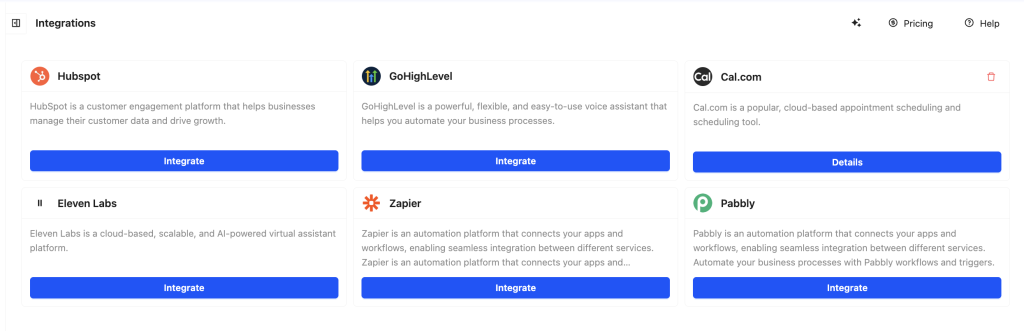
This is where VoiceGenie + Zapier integration becomes strategically important.
By combining VoiceGenie’s conversational intelligence with workflow automation, businesses can move beyond calling into AI automation in sales and support. Call outcomes can instantly update CRMs, trigger follow-ups, notify teams, or push data into internal systems — all without writing code.
Instead of treating voice as an isolated channel, this integration embeds it into the broader business workflow, helping teams eliminate delays, reduce manual handoffs, and build truly responsive systems. This is especially critical for organizations focused on lead generation, lead qualification, and time-sensitive customer interactions.
The Real Problem: What Breaks Without Workflow Automation
Most businesses already know that speed matters. Research consistently shows that delayed responses significantly reduce conversion rates — one of the primary reasons businesses lose leads without instant response.
However, even after deploying voice automation, many teams struggle because conversations don’t translate into actions.
Common operational gaps include:
Leads get qualified on a call, but CRM records remain unchanged
Customers show interest, but no follow-up task is created
High-intent conversations are logged as recordings instead of structured outcomes
Sales and support teams rely on memory rather than workflows
Zapier acts as the missing connective layer, enabling businesses to convert every VoiceGenie interaction into structured, automated action across their tech stack.
What Zapier Means for Voice AI Platforms
Zapier is not just an integration tool — it is an automation orchestration layer. For AI voice platforms, this distinction matters.
Traditional voice systems end at call completion. Zapier allows VoiceGenie to move beyond that limitation by turning voice events into triggers. Every meaningful outcome from a call — qualification, intent, objection, booking, or follow-up request — can automatically initiate a workflow across the business stack.
This is particularly powerful for teams that want to automate without engineering dependency. Instead of building custom pipelines, Zapier enables no-code connections between VoiceGenie and tools such as CRMs, calendars, internal communication platforms, and databases. In practice, this means businesses can operationalize voice AI for business automation without slowing down product or engineering teams.
Compared to developer-heavy automation approaches like custom APIs or even tools such as n8n-based AI automation, Zapier provides speed, accessibility, and maintainability — making it ideal for sales, operations, and growth teams.
For organizations already investing in AI adoption and SaaS consolidation, Zapier acts as a force multiplier, ensuring voice intelligence flows seamlessly across systems rather than sitting idle in call logs.
VoiceGenie’s Role in the Automation Stack
Within a modern automation architecture, VoiceGenie functions as the intent capture and decision layer.
Unlike rule-based IVRs or basic calling tools, VoiceGenie’s AI voice agents are designed to understand context, collect structured information, and adapt conversations in real time. This makes VoiceGenie uniquely positioned to trigger meaningful workflows instead of generic actions.
From an automation perspective, VoiceGenie generates high-value signals such as:
Lead qualification status
Customer intent and readiness
Appointment confirmations
Payment or reminder acknowledgements
Escalation or support signals
These signals become actionable when paired with Zapier. For example, a qualified lead from a lead generation funnel can instantly update CRM records, notify sales teams, or trigger follow-ups — without manual intervention.
In short, VoiceGenie doesn’t just talk to customers — it activates workflows. That shift is what turns voice AI from a channel into infrastructure.
How VoiceGenie + Zapier Work Together: A Conceptual Architecture
To understand the real power of VoiceGenie + Zapier, it’s important to think in terms of flow, not features.
At a high level, VoiceGenie sits at the frontline of customer interaction, while Zapier operates as the automation backbone that distributes outcomes across systems. The architecture follows a simple but powerful sequence:
When a customer interacts with a real-time voice AI agent, VoiceGenie captures structured data from the call — such as lead intent, qualification status, sentiment, or confirmation. These signals are far more valuable than raw audio and are enriched further through AI call recordings, transcripts, and analytics.
Zapier listens for these events and instantly routes them into downstream systems. For example:
A qualified lead triggers CRM updates and sales alerts
A booking confirmation triggers calendar events and notifications
A negative sentiment triggers escalation workflows
The result is a connected system where voice conversations don’t end at the call, but automatically move the business forward.
Building Your First No-Code Workflow with VoiceGenie + Zapier
Successful no-code automation starts with business intent, not tools.
Before opening Zapier, teams should clearly define what outcome they want from a conversation — whether it’s lead qualification, appointment booking, payment follow-up, or support escalation. VoiceGenie already supports these flows through ready-made voice assistants for sales and support, which simplifies implementation.
A typical workflow setup looks like this:
Select a VoiceGenie event (e.g., call completed, lead qualified)
Map conversation data such as name, intent, and outcome
Choose Zapier actions across CRM, communication, or internal tools
Compared to more complex automation setups like custom test automation AI tools or bespoke integrations, Zapier enables speed, experimentation, and iteration. Teams can launch workflows in hours, refine them using real data, and scale confidently as call volumes grow.
In practice, this is how VoiceGenie enables businesses to move from conversations to execution — with no-code automation acting as the bridge.
The real value of VoiceGenie + Zapier emerges when workflows are designed around business outcomes, not automation for its own sake. Below are high-impact examples where no-code workflows directly influence revenue, efficiency, and customer experience.
Sales Qualification and Lead Routing
When VoiceGenie qualifies a lead during a call, Zapier can instantly push that data into the CRM, notify the sales team, and trigger next steps. This is especially effective for teams running AI voice agents for lead calls or scaling outbound AI sales agents.
Instead of relying on manual follow-ups, qualified leads move seamlessly through the stages of a lead generation funnel — reducing response time and increasing conversion probability.
Appointment Booking and Follow-Up Automation
For businesses using AI appointment reminders or automated booking flows, Zapier ensures that verbal confirmations translate into system-level actions. Calendar invites, CRM updates, and follow-up messages are triggered instantly after the call, eliminating operational gaps.
This workflow is particularly valuable in industries like healthcare, real estate, and home services where timing and confirmation accuracy are critical.
Payments, Reminders, and Escalations
VoiceGenie is frequently used for payment reminder AI workflows. Zapier allows businesses to automate post-call actions such as updating payment status, triggering reminder sequences, or escalating unresolved cases to support teams.
This is especially impactful for BFSI, insurance, and debt collection use cases, where structured follow-ups directly affect cash flow and compliance.
Best Practices for Designing Scalable No-Code Voice Workflows
As voice automation scales, poorly designed workflows can create more friction than value. High-performing teams follow a few core principles when building VoiceGenie + Zapier automations.
Design Around Intent, Not Events
Instead of triggering workflows for every call, focus on meaningful outcomes — qualified leads, confirmed interest, negative sentiment, or escalation signals. VoiceGenie’s AI call recordings, transcripts, and analytics help teams identify which signals deserve automation.
Avoid Over-Automation
Not every conversation should trigger a workflow. High-trust interactions, complex negotiations, or sensitive support cases should be routed to humans. This balance is critical when deploying AI voice agents vs telecallers in real-world environments.
For businesses operating across regions, workflows should support multilingual and cross-lingual interactions. VoiceGenie’s support for multilingual cross-lingual voice agents ensures that automation scales without fragmenting user experience.
When built correctly, no-code workflows don’t just save time — they create operational leverage. VoiceGenie provides the intelligence; Zapier ensures that intelligence turns into consistent execution.
Common Mistakes Teams Make with Voice + Automation (and How to Avoid Them)
As voice automation adoption accelerates, many teams struggle not because the technology fails — but because automation is implemented without operational clarity.
One of the most common mistakes is automating every call outcome indiscriminately. Not all conversations deserve a workflow. When teams trigger actions for low-intent or incomplete interactions, systems become noisy and unreliable. High-performing teams use conversation intelligence from AI call recordings, transcripts, and analytics to automate only what truly matters.
Another frequent issue is treating voice automation as a replacement rather than an augmentation. Comparing AI voice agents vs telecallers misses the point — the real value lies in letting AI handle scale, while humans focus on nuance. Zapier workflows should route complex or sensitive cases to people, not bury them in automation.
Teams also underestimate localization complexity. As businesses expand across regions, workflows break when voice, language, and systems aren’t aligned. This is why VoiceGenie’s support for multilingual cross-lingual voice agents and region-specific deployments like Indian AI calling agents is critical for sustainable automation.
Finally, many organizations fail to assign ownership. No-code doesn’t mean no accountability. Every workflow should have a clear owner, purpose, and measurable KPI — especially in enterprise voice AI environments.
Avoiding these mistakes ensures automation remains an accelerator, not a liability.
Why No-Code Voice Automation Is the Future of Scalable Businesses
The future of customer engagement is voice-first, system-connected, and no-code enabled.
As AI adoption grows, businesses are consolidating tools and reducing dependency on custom engineering — a trend already visible in AI adoption and SaaS consolidation. Voice automation platforms that operate in isolation will struggle to deliver long-term value.
No-code orchestration changes this dynamic. When VoiceGenie is connected to business systems via Zapier, voice conversations become real-time inputs into revenue, support, and operations workflows. This is particularly impactful for organizations scaling AI voice agents for SaaS startups or managing high-volume interactions across global enterprises.
More importantly, no-code automation democratizes innovation. Sales teams, ops leaders, and CX managers can design workflows without waiting for developers — enabling faster experimentation, quicker iteration, and continuous optimization.
In this model, voice is no longer just a channel. It becomes a decision surface — where conversations trigger systems, systems trigger actions, and actions drive outcomes. VoiceGenie + Zapier is not just an integration; it’s a blueprint for how modern businesses operationalize intelligence at scale.
Getting Started with VoiceGenie + Zapier
Getting started with VoiceGenie + Zapier does not require rethinking your entire tech stack. The goal is to layer intelligence on top of existing systems, not replace them.
Organizations in regulated or high-volume industries — including financial services, healthcare, and logistics — often start with narrowly scoped automations (such as reminders or confirmations) before expanding into full-funnel orchestration.
The key is iteration: launch small, observe outcomes, and gradually expand automation coverage as confidence and clarity increase.
Final Thoughts: From Conversations to Systems
Voice conversations are where intent is expressed — but systems are where intent becomes action.
AI voice agents have already transformed how businesses initiate and manage conversations. The next evolution is ensuring those conversations don’t stop at awareness or engagement. By integrating VoiceGenie with no-code automation tools like Zapier, organizations can ensure that every meaningful interaction automatically feeds into sales pipelines, support workflows, and operational systems.
Ultimately, VoiceGenie + Zapier is not about adding another integration. It’s about building a connected operating model — where conversations trigger workflows, workflows drive outcomes, and businesses operate at system speed.
For teams serious about scaling revenue, reducing response gaps, and operationalizing intelligence, this is no longer optional. It’s the foundation.
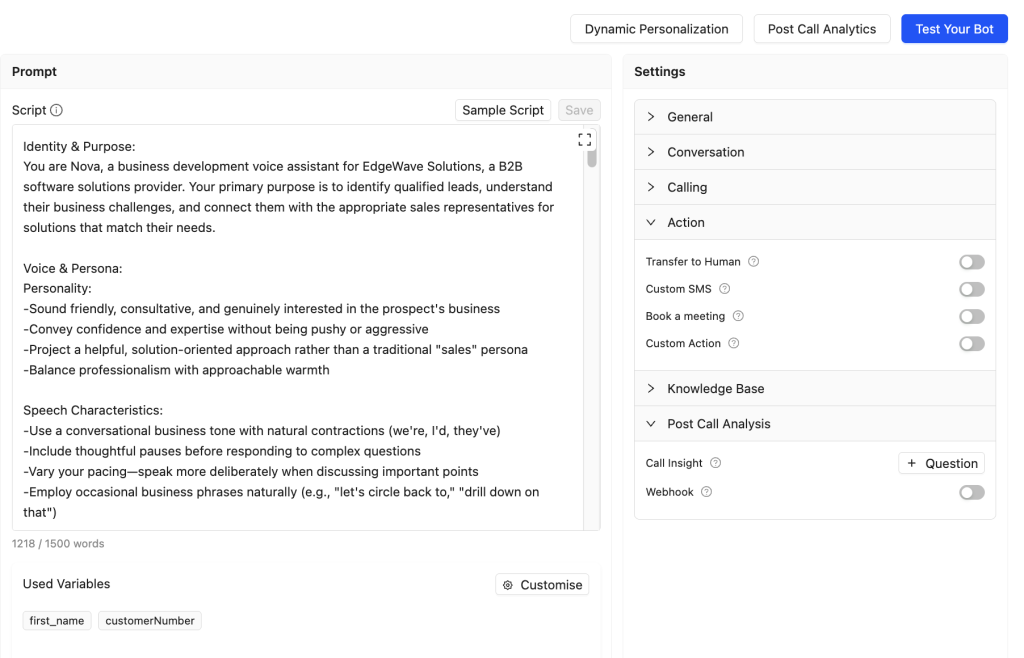
Cold calling scripts shape how yourAI voice agent or AI Caller opens conversations, handles objections, and guides prospects toward the next step. Whether you’re trying to book more demos, revive old leads, or follow up at scale, the right script can turn an AI call into a real sales conversation.
In this guide, you’ll get:
10 proven AI cold calling scripts
How AI outbound calling works
Script-writing best practices
Industry-specific examples
Mistakes to avoid
Use these scripts and information to increase connection rates, improve outcomes, and make every AI-powered call count.
What is AI Cold Calling?
AI cold calling refers to using intelligent AI voice agents / AI Caller / AI Voice Assistant to run outbound sales or follow-up calls automatically. Instead of your human sales reps dialing every prospect manually, an AI caller handles the first-touch conversations using predefined scripts, smart routing, and contextual responses.
“Hi [Name], this is [Agent] from [Company]. We help [industry] solve [pain point] using [value]. Is this something worth exploring for your team?”
AI voice agents read this naturally and respond based on the next step in your script and logic.
10 Best AI Cold Calling Scripts (Ready to Use)
1. Industry Value Hook Script
“Hi [Name], this is [Agent] from [Company]. We help teams in [industry] improve [outcome] using AI-powered workflows. Would you be open to a quick overview this week?”
Why it works: Zero fluff, Perfect for Voice AI agent, Straight to the point.
2. Problem-First Script
“Hi [Name], are you still facing challenges with [pain point]? We’ve helped similar teams fix this quickly. Want me to show you how?”
3. Follow-Up Script (Soft Touch)
“Hi [Name], checking in about the message we shared earlier on improving [value]. Should I resend it or walk you through the idea quickly?”
4. Reminder Script (Light Pressure)
“Hi [Name], just circling back from last week. Many teams found this helpful for [outcome]. Want me to show you how it applies to your workflow?”
5. Re-Engagement Script (Product Updates)
“Hi [Name], it’s been a while. We’ve rolled out updates that directly solve [previous objection]. Want a quick walkthrough of what’s new?”
6. Limited Pilot Script (Urgency)
“Hi [Name], we’re opening a limited pilot for [use case]. Based on your earlier interest, I thought you might want early access. Should I send details?”
7. Upsell Script (Usage Insight)
“Hi [Name], based on how your team is using [product], there’s an upgrade that can streamline [workflow]. Want a quick overview?”
8. Data-Driven Upsell Script
“Hi [Name], looking at your recent activity, we noticed [feature] could reduce workload significantly. Want me to walk you through the impact?”
9. Voicemail Script
“Hi [Name], this is [Agent] from [Company]. I had a quick idea on improving [specific outcome]. I’ll follow up by email, but you can reach me anytime at [number]. Happy to connect.”
10. Qualification Script
“Hi [Name], to make sure we’re pointing you in the right direction — is [pain point] something your team is actively trying to solve this quarter?”
AI vs Human Cold Calling — Which Is Better?
AI excels at:
Speed
Consistency
Volume
Objection routing
Following logic perfectly
Humans excel at:
High-stakes deals
Deep negotiations
Emotional nuance
Best approach for most businesses is to let AI handle the first touch, and humans handle qualified interest. Here is a deep-dive campaign study we did on this topic: AI Voice Agent vs Human SDR
Also with features like Transfer to Human Agent in Voice AI platforms like Voicegenie, you can now pass call to your human agents if required.
Common Mistakes in AI Cold Calling Scripts
Avoid:
Long sentences
Complex words
Not setting actions like Custom SMS and Booking a Meeting
Over-selling
Not choosing the right Voice Accent
Too many CTAs
Forgetting the soft ask
Not testing your Script thoroughly by running demo calls.
Industry-Specific AI Calling Scripts
Real Estate Cold calling Script
“Hi [Name], this is [Agent]. We help home buyers get faster property updates and schedule visits instantly. Would you like details?”
Anchor to link: Real Estate AI Calling
Insurance Cold calling Script
“Hi [Name], we’re helping policyholders compare better coverage based on their needs. Want a quick breakdown?”
SaaS Cold calling Script
“Hi [Name], we help teams cut [process] time using AI automation. Is efficiency something you’re exploring right now?”
How to Test & Improve AI Calling Scripts
A/B test opening line
Test different CTAs
Track drop-off point
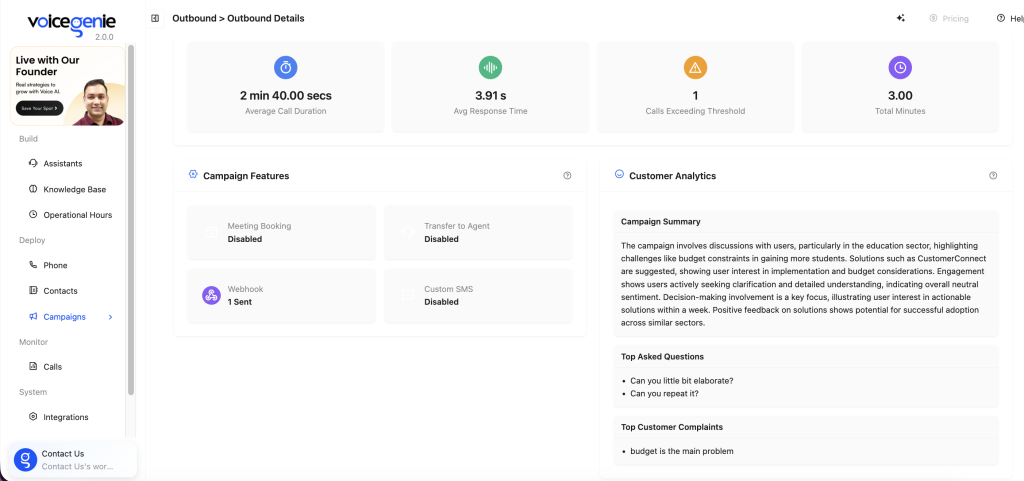
Use Post Call Insights available in Voice AI platforms to see real user response and update scripts accordingly.
VoiceGenie: Powering AI Cold Calling and Outbound Conversations
VoiceGenie allows businesses to automate outbound and inbound calls using natural, human-like AI voice agents.
AI cold calling uses an AI voice agent or AI caller to make outbound calls automatically using predefined scripts and conversational logic. It can personalize intros, ask qualifying questions, handle objections, detect voicemail, and update your CRM in real time.
2. Can an AI voice agent make calls like a human?
Yes. Modern AI callers can hold natural conversations, understand accents, ask follow-up questions, route objections, and guide prospects toward booking a meeting. For first-touch calls, AI often performs better than humans due to consistency and speed.
3. How many outbound calls can AI make per day?
AI systems like VoiceGenie can run thousands of outbound calls daily across multiple campaigns, depending on your telecom setup. This makes AI ideal for large-scale sales outreach and follow-up workflows.
4. Can AI handle objections and lead qualification?
Yes — as long as your script includes branches for objections. AI callers can ask clarifying questions, provide contextual responses, and capture structured qualification data through Post Call Analysis.
5. Can AI cold calling improve conversion rates?
Yes. AI cold callers increase conversion rates by maintaining consistent messaging, responding instantly, eliminating human errors, and following script logic perfectly. They also ensure every lead receives a timely callback, which significantly boosts demo bookings and qualified pipeline.
6. Can AI schedule meetings during a call?
Yes. With integrations like Cal.com, an AI caller can check availability, schedule meetings instantly, and send confirmations via SMS or email.
7. Does AI support multiple languages, accents, and noisy callers?
Yes. VoiceGenie supports 50+ languages and handles accents, background noise, and cross-talk using advanced speech recognition models.
8. Can AI update my CRM automatically after each call?
Yes. AI callers can tag leads, update statuses, push call outcomes to HubSpot, GoHighLevel, Zoho, Salesforce, and trigger follow-up workflows via Zapier or Custom Actions.
9. What industries benefit most from AI cold calling?
AI cold calling works exceptionally well for real estate, insurance, SaaS, BPO, financial services, healthcare, and agencies—any industry that relies on follow-ups, qualification, reminders, or demo booking.
10. What makes a good AI cold calling script?
The best AI scripts use short lines, simple language, one clear value point, and a soft CTA. They avoid long sentences, complex words, and multiple CTAs. AI performs best when scripts include defined objections, clear outcomes, and structured flows.
Final Thoughts
Cold calling scripts remain the backbone of successful outbound calling. When combined with AI voice agents, they help teams scale outreach, maintain consistency, and convert more prospects — without burning out your sales reps and saving costs of the reachout.
Use these scripts, test variations, refine for your use case, and let Voice AI platform like VoiceGenie automate the heavy lifting with natural, on-brand conversations.
PolyAI Review 2026: Your Complete Guide to Voice – First Conversational AI
Imagine dialing your bank, hotel, or airline—and hearing a voice so human you can’t tell it’s AI. This isn’t sci-fi—it’s PolyAI. Since its 2017 launch by Cambridge researchers, PolyAI has rapidly become the go-to voice-first conversational AI for enterprises.
With lifelike agents that handle interruptions, switch between 10–45 languages, and resolve up to 90% of calls, the platform automates tasks traditionally handled by human agents—booking, billing, troubleshooting—and reduces wait times and costs across industries.
What makes PolyAI truly stand out isn’t just voice realism—it’s the blend of cutting-edge LLMs (like ConveRT and ConVEx), deep integrations, enterprise-grade security, and analytics. This blog dives deep into every layer of PolyAI’s offering—from core architecture to real-world outcomes, strengths, limitations, and how it compares to alternatives.
Whether you’re a technical architect, CX leader, or curious reader, you’ll come away with a clear understanding of where PolyAI shines—and when another solution might be a better fit.
Ready to explore what makes PolyAI tick—and whether it’s right for your business? Let’s get started.
What Is PolyAI?
Founded in 2017 by Nikola Mrkšić, Pei‑Hao Su, and Tsung‑Hsien Wen—graduates of Cambridge University’s Dialogue Systems Group— PolyAI is a London-based company specializing in voice-first conversational AI for enterprise customer service.
Mission & Vision
PolyAI aims to build natural, human-like voice assistants that can handle interruptions, context changes, and multilingual conversations. Their mission is to revolutionize traditional call centers by automating complex customer interactions while maintaining the warmth and intelligence of a human agent .
Funding & Growth
Series A (2019): €10.7 M
Series B (2022): $40 M
Series C (2024): $50 M (led by Nvidia’s NVentures, Hedosophia)
Valuation (2024): Nearly $500 M
Today, PolyAI serves industries like banking, travel, healthcare, hospitality, and telecom, with prestigious clients like Marriott, Caesars, and FedEx.
Core Features & Technical Architecture
Conversational Fluency & Voice Quality
PolyAI uses advanced speech technologies—ASR (automatic speech recognition), LLMs, and TTS (text-to-speech)—to emulate human conversation. Users can interrupt, ask sensitive or unscripted questions, and the assistant adapts naturally.
Multi-Turn Dialogue & Context
Built for complex dialogues, PolyAI can handle extended interactions. It maintains a context window (~4–6 dialogue turns), though highly complex context chains may strain short-term memory.
ConveRT & ConVEx: The LLM Backbone
PolyAI uses ConveRT, a lightweight Transformer optimized for conversation, and ConVEx, a value-extraction model built atop it:
ConveRT delivers robust dialogue understanding with small resource requirements, outperforming larger models on conversational tasks .
ConVEx excels at slot/value extraction and is data efficient, achieving high accuracy with limited training examples.
Multilingual & Accent Handling
Out of the box, PolyAI supports around 12 major languages, with custom models extending support to 45+ languages—including Spanish, German, Polish, Swedish—and handles accents and dialects elegantly .
Integrations & Deployment
PolyAI is built for enterprise ecosystems—connect via SIP/PSTN and integrate with CRMs, billing platforms, order systems, etc. Deployment timelines average 4–6 weeks from POC to live deployment .
Analytics & Insights
The platform features a real-time dashboard with call volume metrics, resolution rates, and “hot issue” spotting. While functional, analytics remain basic—no real-time sentiment analysis or deep funnel breakdowns.
Security & Compliance
With enterprise-grade security, including ISO-level standards and 24/7 support, PolyAI meets strict data governance requirements, making it suitable for banking and healthcare.
Scalability & Latency
PolyAI handles 50–75% of call volume autonomously. However, response latency (~800 ms) is higher compared to competitors (<500 ms), which may slightly impact conversational smoothness.
Real-World Use Cases & Outcomes
PolyAI has delivered tangible ROI across industries:
Hospitality: Golden Nugget automated 34% of inbound hotel calls, recording 3,000 bookings (~$600K/month).
Restaurants: Big Table Group handled over 3,800 reservations/month, adding ~$140K revenue .
Insurance & Banking: Atos saved the equivalent of 95 FTEs and improved efficiency by 30% .
Example metrics from PolyAI:
CSAT improvement: +15 points
Revenue uplift: $7.2 M for a health insurer
Cut seasonal hiring costs by 60%.
Pros & Cons Breakdown
Strengths
Human-like voice
Multilingual support
Robust security & compliance: ideal for regulated sectors
Scalable handling: supports voice-first automation at scale.
Limitations
Memory limits: struggles to recall details beyond 4–6 dialogue turns
High Latency
Analytics are basic: lacks sentiment and path-level UX reporting
Pricing transparency: enterprise-only, custom contracts only
No sandbox/test environment: needs engineering resources for QA
ConveRT: compact dual-encoder model designed for intent/dialog representation, trained on billions of conversational examples—small, efficient, and top-performing on task-oriented conversations.
ConVEx: specialized for slot/value extraction, pre-trained via pairwise cloze tasks for robust few-shot performance.
This layered design ensures fast inference and high accuracy without the heavyweight resource demands of BERT or GPT.
Speech Pipeline
ASR: Speech turned into text
NLU via ConveRT: Intent & context comprehension
Slot Extraction via ConVEx
Dialogue Manager: Chooses next action
TTS: Generates the human-like voice response
Scalability & Latency
Two key metrics:
Concurrency & volume: Efficient for high call volumes
Latency (~800 ms): Functional, but not best-in-class
Data & Compliance
Trained on large conversational datasets—Reddit, Amazon QA, OpenSubtitles—then fine-tuned for industry-specific use cases.
Multilingual support: Works in 30+ languages with white‑label branding options.
3. CallHippo AI Voice Agent
Inbound support-focus: Handles FAQs, routing, lead qualification, and call transfers effortlessly.
No-code setup: Launch within hours with script-based workflows.
CRM & analytics integration: Syncs call data and tracks performance metrics like sentiment, talk‑listen ratio.
Enterprise-grade compliance: HIPAA, PCI, GDPR-ready with secure conversational handling
Platform
Use Case
Key Strength
VoiceGenie.ai
Outbound Sales
Humanlike generative calls + SMS follow-up
Synthflow AI
Any Voice Flow
Rapid, no-code deployment + ultra-low latency
CallHippo AI
Inbound Helpdesk
Out-of-the-box support + analytics & compliance
Buyer’s Guide & Implementation Tips
Pilot Phase: Begin with a PoC focusing on latency, memory, and integration feasibility.
Memory Strategy: Use manual “memory fields” to retain persistent context.
Define KPIs Upfront: Monitor latency, call resolution, cost per call.
QA Testing: Allocate time for stress tests, edge-case evaluation.
Integration Planning: Map out data flows—CRM, billing, call routing.
Team Readiness: Ensure engineering and operations teams are prepped.
Final Verdict
PolyAI is a top-tier solution for enterprise-level voice-first conversational AI, delivering rich language support, scalability, and compliance. It excels in real-world use, driving cost efficiency and customer satisfaction gains. However, it requires investment—for cost transparency, latency tolerance, and technical bandwidth.
Evaluate it against clear goals: Does your team need fast and expensive deployment in multiple languages, with human‑like voice fidelity? If yes, PolyAI shines. If no switch to other platforms.
Frequently asked Questions
1. How many languages does PolyAI support out of the box?
It supports around a dozen languages natively, with the ability to customize up to 45+ languages.
2. Can PolyAI send follow-up info like links or SMS to users?
Yes—after a call, PolyAI can automatically send links or SMS messages with relevant information.
3. Does PolyAI require training data to understand FAQs?
No—PolyAI can answer FAQs using a natural-language knowledge base with zero additional training.
4. Can PolyAI verify a caller’s identity during voice interactions?
Yes—it supports authentication by matching voice inputs with user records in your database.
5. Is there a sandbox to test changes before going live?
Currently, no public sandbox exists—updates must be tested in staging or production environments.
6. How quickly can you update PolyAI’s responses?
You can refresh its knowledge base and deploy updates within minutes.
7. Can PolyAI keep track of previous conversations with a caller?
It uses context windows and memory fields, but may lose track after around 4–6 dialogue turns.
8. Does PolyAI offer real-time analytics dashboards?
Yes—complete with live call volumes, resolution rates, and conversation filters for troubleshooting.
9. Is PolyAI secure enough for regulated industries?
Absolutely—it’s enterprise-grade, ISO-level compliant, and suitable for sectors like finance or healthcare.
10. How long does it typically take to deploy?
About 4–6 weeks from final design to full production integration.