Launching a Voice AI agent is exciting. Calls are being answered, leads are being qualified and customers are getting help without waiting.
Then the question hits you.
Is this actually moving the needle for lead generation and revenue, or is it just another automation tool that looks good on paper.
The only honest answer comes from numbers. You need clear KPIs for measuring Voice AI impact on sales funnel performance and on lead generation, so you can see exactly where the AI helps and where it needs work.
This guide gives you a concrete KPI blueprint that you can apply directly to VoiceGenie or any other Voice AI platform.
You will learn:
- Where Voice AI fits in the sales and lead generation funnel
- The most important Voice AI lead generation KPIs
- Which KPIs best demonstrate the impact of AI voice agents on contact center performance
- What KPIs you should watch to know if Voice AI is really speeding up your sales funnel
By the end, you will have a short list of metrics that make Voice AI performance impossible to ignore.
Where Voice AI fits inside your funnel
Before you pick KPIs, you need to know what you want Voice AI to do.
Most teams use Voice AI at one or more of these stages:
- Top of funnel lead capture from inbound calls, contact forms and campaign numbers
- Lead qualification and appointment setting for sales teams
- Sales support during live calls, renewals and upgrades
- Contact center support for existing customers
Your KPIs should always match that job. If Voice AI is mainly handling inbound lead qualification, measuring it only with contact center metrics will never tell the full story.
Keep that in mind as you go through the KPI list. Pick the ones that line up with the role your AI is playing today.
Top of funnel KPIs for Voice AI lead generation
This is where people search, click ads, visit your site and call you for the first time. You want to measure how well Voice AI turns that attention into leads.
These are the core Voice AI lead generation KPIs:
Call coverage rate
Percentage of inbound calls that are answered by a human or a Voice AI agent. If coverage jumps from sixty percent to near one hundred percent after Voice AI, you know you are no longer wasting demand.
Speed to first response
Average time from first call or form fill to the first real conversation. One of the strongest KPIs for measuring Voice AI impact on lead generation is the drop in this number. Voice AI should take you from hours to seconds.
Lead capture rate
Number of unique leads where Voice AI captured correct contact details and permission to follow up, divided by total inbound calls. This tells you how often calls are turning into actual opportunities in your CRM.
Lead qualification start rate
Percentage of conversations where the AI successfully starts your qualification flow. If callers hang up before this point, your greeting and opener need work.
Opt in rate by campaign
For each campaign or number, track how many callers agree to answer qualification questions or book a meeting through Voice AI. This shows you which campaigns are bringing in Voice AI friendly traffic and which ones are just noise.
If you only track one metric at the top of the funnel, make it the combination of coverage rate plus lead capture rate. Together they show how much extra pipeline Voice AI is bringing in.
Mid funnel KPIs for lead qualification and meetings
Once Voice AI has captured a lead, the next job is to qualify and move them toward a real sales conversation.
Here are the KPIs for measuring Voice AI impact on this part of the funnel:
Qualified lead rate
Number of leads that pass your Voice AI qualification rules, divided by all leads that spoke with the agent. This tells you whether the script and criteria are filtering correctly.
Appointment set rate
Percentage of qualified leads where the AI successfully books a meeting, demo or discovery call. For outbound Voice AI campaigns this is often the north star metric.
No show reduction
Change in meeting no show rate before and after Voice AI follow ups and reminders. Smart agents can confirm attendance, reschedule and keep your calendar full.
Pipeline created through Voice AI
Total value of qualified opportunities that entered your CRM as a direct result of Voice AI conversations in a period. That number is hard for any stakeholder to ignore.
When someone asks what KPIs you should watch to measure the impact of a Voice AI on your lead generation funnel, this group is usually the answer.
Bottom of funnel KPIs for revenue impact
At the conversion stage, Voice AI is supporting sales reps, answering final questions and sometimes closing simple deals on its own.
To understand revenue impact, track:
Voice assisted conversion rate
Percentage of opportunities that had at least one Voice AI touch and reached your main revenue goal such as purchase, subscription or contract signature.
Deal speed
Average time from first qualified conversation to closed deal for leads touched by Voice AI versus leads that never interacted with it. If your AI is doing its job, deals that involve Voice AI should move faster.
Revenue per lead touched by Voice AI
Total revenue from Voice AI influenced deals divided by the number of leads that spoke with the agent. This shows whether the AI is bringing in better qualified, higher value prospects.
Win rate uplift
Difference in win rate between opportunities that involve Voice AI and those that do not. Even a few percentage points here can be huge at scale.
These are the numbers that show whether Voice AI is truly changing your sales funnel or only making it feel busier.
KPIs for contact center and customer support performance
Some of your queries mention contact centers directly, so this section is important.
When Voice AI is used in support or service environments, the question becomes: which KPIs best demonstrate the impact of AI voice agents on contact center performance.
Here are the essential ones:
Containment rate
Percentage of calls fully handled by the AI without transfer to a human. Higher containment means more resolved issues without extra headcount.
First contact resolution
Share of issues that are solved in a single interaction, whether by AI alone or by AI plus one agent. If this improves after Voice AI, your customer experience is better.
Average handle time change
Difference in average handle time for calls that involve Voice AI versus those that do not. Sometimes handle time goes down because AI resolves questions faster. Sometimes it goes up slightly but leads to better resolution. Track both time and satisfaction.
Queue time and abandonment rate
With AI taking a share of calls, customers should spend less time waiting for a human. Lower queue times and fewer abandoned calls are strong signs that the system works.
Customer satisfaction after AI calls
CSAT or star ratings collected right after Voice AI interactions. This is the safety check that tells you customers still feel heard and helped.
Support leaders can use this small KPI set to see whether Voice AI is protecting service quality while freeing up agents.
KPIs that prove Voice AI is speeding up your sales funnel
Many executives ask a very specific question.
What KPIs should I watch to know if a Voice AI is really speeding up our sales funnel.
You do not need a long list here. Focus on three numbers:
Time to first conversation
From inbound lead creation to the first real conversation of any kind, human or AI. Voice AI should cut this time dramatically.
Time from first conversation to opportunity created
How long it takes for leads to move from first call to a qualified opportunity in your CRM. Faster movement here means your pipeline fills more quickly.
Time from opportunity to closed revenue
How quickly deals close when Voice AI is involved versus when it is not.
If Voice AI reduces all three time spans, it is speeding up your sales funnel. If not, you know where to investigate.
How to build a simple Voice AI KPI dashboard
You do not need a complex business intelligence stack to get started. Begin with a basic dashboard that pulls data from three places:
- Your Voice AI platform for conversation level metrics
- Your CRM for leads, opportunities and revenue
- Your contact center or help desk tool for support metrics
At minimum, your dashboard should show:
- Calls handled by Voice AI per day and per campaign
- Coverage rate and speed to first response
- Qualified lead rate and appointment set rate
- Voice assisted conversion rate and revenue influenced
- One or two contact center metrics if support is part of the scope
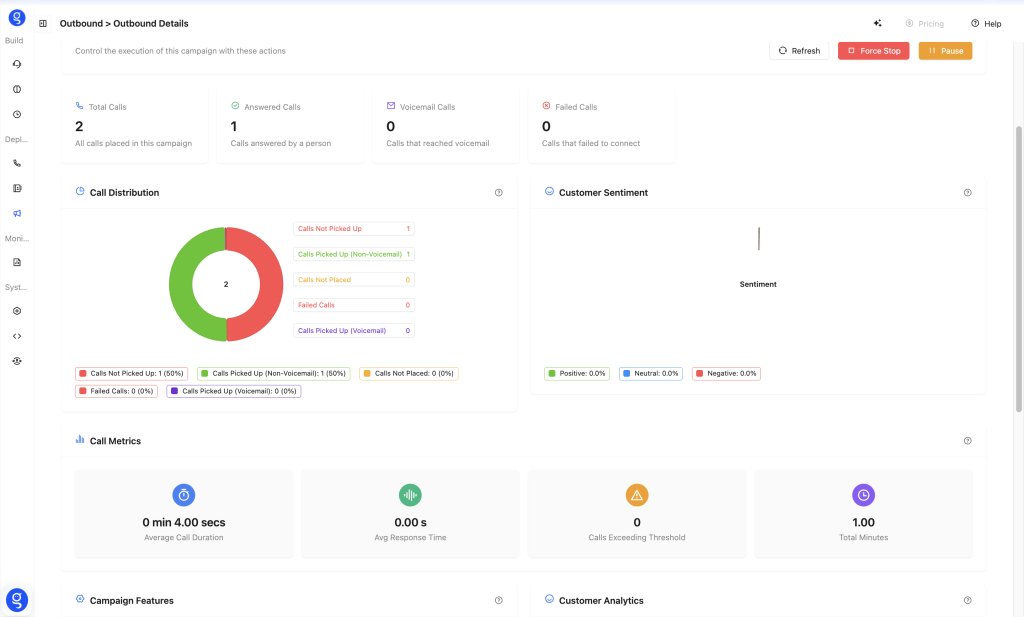
Review this weekly with sales and support leaders. The goal is not a perfect report, but a living view of how Voice AI performance changes as you adjust scripts and routing.
Improving your KPIs over time
Tracking is only half the game. The real impact comes from acting on the data.
Here are three simple habits that move your KPIs in the right direction.
Listen to real calls once a week
Pick ten Voice AI calls at random and listen with your team. Mark moments where the agent misunderstood, where the script felt stiff or where a rep had to repeat questions the AI already asked. Use these insights to refine prompts and flows.
Run small A B tests
Try two versions of a greeting, two qualification paths or two offers and compare KPIs such as appointment set rate and conversion rate. Voice AI makes it easy to test ideas without retraining an entire human team.
Feed real outcomes back into the model
Use your best conversations and closed deals as training examples so intent recognition and response quality keep improving. When you invest in model quality, metrics like containment rate, CSAT and revenue per lead tend to rise together.
FAQ
1. What KPIs should I watch to measure the impact of a Voice AI on our lead generation funnel
Start with coverage rate, speed to first response, lead capture rate, qualified lead rate and appointment set rate. Together, these show how many extra leads Voice AI captures, how quickly it responds and how well it moves people toward a sales meeting.
2. What KPIs should I watch to know if a Voice AI is really speeding up our sales funnel
Focus on time to first conversation, time from first conversation to opportunity and time from opportunity to closed deal. Compare these numbers for leads touched by Voice AI versus leads handled only by humans.
3. Which KPIs best demonstrate the impact of AI voice agents on contact center performance
Containment rate, first contact resolution, queue time, average handle time and customer satisfaction after calls are the clearest indicators. Together they show whether Voice AI is reducing workload while keeping customers happy.
4. How do KPIs for measuring Voice AI impact on lead generation differ from sales KPIs
Lead generation KPIs focus on how many new leads you create and qualify, such as coverage rate, lead capture rate and qualified lead rate. Sales KPIs focus on what happens after that, such as conversion rate, revenue per lead and deal speed. You need both to see the full picture.
5. How often should we review Voice AI KPIs
Most teams do a light review every week and a deeper review each month. Weekly reviews catch sudden drops or spikes. Monthly reviews are better for seeing trends and making strategic changes to scripts, routing and campaigns.
Leave a Reply