AI voice agents are no longer experimental tools — they’re now a core part of sales, support, and operations across modern businesses. AI Voice Agents Platforms like VoiceGenie help teams automate outbound calls, incoming calls, qualify leads, follow up instantly, and manage conversations at scale.
But the real question business leaders ask is:
“How do we measure if our AI calls are actually working?”
KPIs give you a clear, data-backed picture of:
- whether your AI agent is connecting with leads
- how deeply people engage
- how well the AI Voice Agent qualifies or resolves queries
- how many outcomes it produces
- and ultimately… whether it drives ROI
This blog breaks down the Top 8 KPIs that matter for any AI calling Voice Agent workflow — whether you’re running sales outreach, reminders, qualification campaigns, or customer updates.
Use these KPIs to track performance, improve workflows, and ensure every AI-powered call contributes to revenue and efficiency.
Why KPIs Matter for AI Voice Agents
A KPI (Key Performance Indicator) is a measurable metric that shows how effectively a system is performing against business objectives.
In the context of AI voice calls, KPIs help you answer:
- Are calls connecting?
- Are leads responding to the AI Voice Agent?
- Is the AI collecting the right information?
- Are outcomes being achieved consistently?
- Is this lowering cost and increasing conversions?
This is where VoiceGenie gives you an advantage — the platform automatically:
- captures call outcomes
- logs structured answers
- shows sentiment
- tracks performance in real time
- and syncs everything with your CRM
So every KPI becomes actionable, not just informational.
The Top 8 KPIs to Measure AI Voice Agent Success
Below are the KPIs most relevant to the capabilities inside VoiceGenie AND the queries your page ranks for in GSC.
1. Connection Rate
What it is:
The percentage of outbound calls that connect to a real human.
Why it matters:
A low connection rate often means issues with:
- lead quality
- wrong calling time
- carrier filtering
- outdated lists
High connection rate = more conversations = more outcomes.
VoiceGenie Insight:
Optimized calling time and smart retries often improve connection rates by 20–30%.
2. Lead Engagement Rate
What it is:
Percentage of connected leads who actually interact with the AI (respond, answer questions, or continue the dialogue).
Why it matters:
Even if a call connects, it doesn’t mean the lead participates.
This KPI shows whether your script is relevant and effective.
VoiceGenie Insight:
A Good script with an interactive Opening line, Human-like responses, dynamic conversational flows, and multilingual support increase engagement naturally.
3. Qualification Rate
What it is:
Percentage of calls where the AI successfully gathers required details naturally through conversation::
Examples:
- budget
- timeline
- interest
- address
- customer intent
Why it matters:
For sales teams, qualification is everything.
For support teams, it ensures accurate routing.
For operations, it ensures your workflows fire correctly.
4. First Call Resolution (FCR)
What it is:
How often the AI resolves the lead’s query or objective in the first call — without needing a human agent.
Why it matters:
High FCR = fewer follow-ups, lower cost, faster results.
Examples of first-call resolutions:
- completing a payment reminder
- confirming an appointment
- answering FAQs
- capturing lead details
- resolving simple support queries
VoiceGenie Insight: Well-designed conversation script significantly increase FCR.
5. Average Talk Time
What it is:
The average length of conversations between the AI and the lead.
Why it matters:
- Too short = poor engagement
- Too long = inefficiency
Healthy talk time shows the AI is holding meaningful conversations without wasting time.
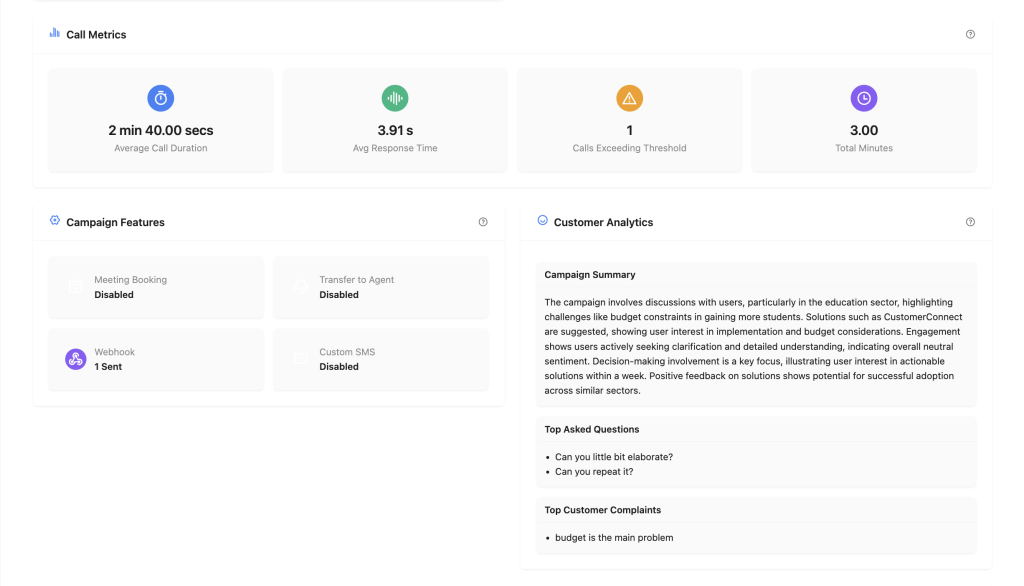
6. Lead-to-Outcome Conversion Rate
What it is:
The percentage of calls that lead to a defined successful outcome.
Why this KPI is powerful:
Every campaign has different goals, so this KPI adjusts to your workflow:
Outcomes may include:
- meeting booked
- SMS sent
- webhook fired
- lead qualified
- renewal confirmed
- payment commitment captured
- callback scheduled
- voicemail detected and message dropped
- intent recorded
- application filled
This single KPI shows how effectively your AI drives the intended business result.
7. Follow-Up Compliance Rate
What it is:
The percentage of scheduled follow-ups the AI actually completes — on time and in sequence.
Why it matters:
– Follow-up is where deals and conversions happen.
– AI removes human error from follow-up workflows.
VoiceGenie Insight:
Automatic retries, voicemail detection, and SMS triggers significantly improve follow-up consistency.
8. ROI / Cost per Outcome
What it is:
The financial efficiency of AI calls.
Formula:
ROI = (Revenue Generated – Cost of Calls) / Cost of Calls × 100
Why it matters:
This is the ultimate KPI businesses look at — whether AI is profitable or whether it is more profitable than having a human team.
VoiceGenie reduces manual calling costs significantly and increases throughput, improving ROI even with small teams. You can find our study on the same here : AI Human Agent vs Human SDR
How VoiceGenie Helps You Improve These KPIs
VoiceGenie includes features engineered to optimize every one of these KPIs:
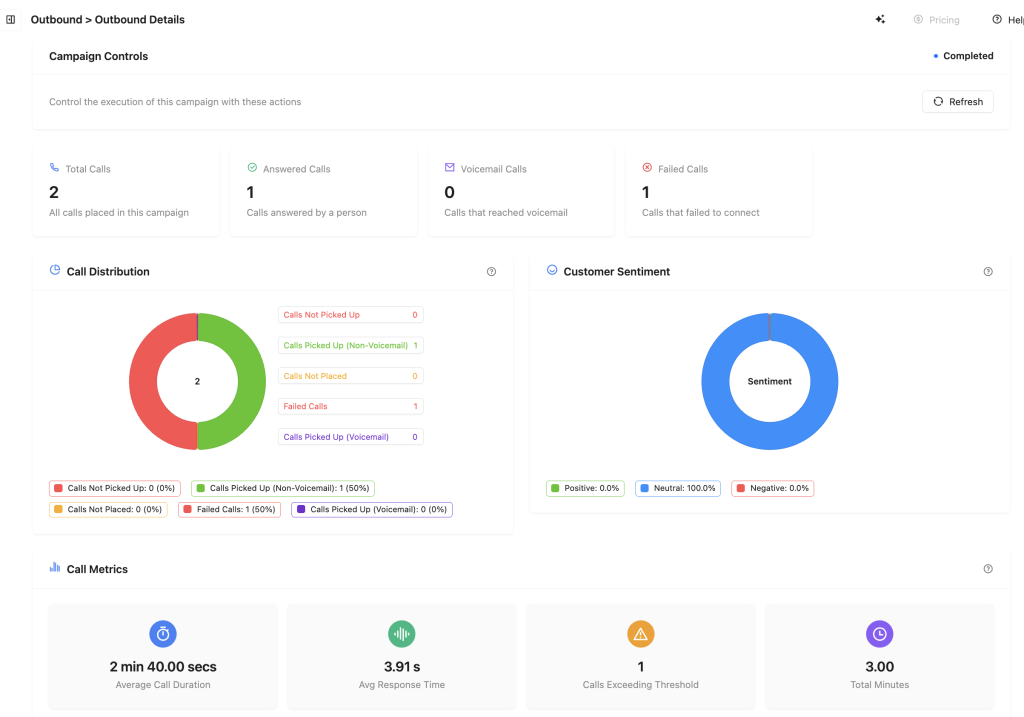
- Real-time analytics dashboard
- meeting booked
- SMS sent
- webhook fired
- lead qualified
- renewal confirmed
- payment commitment captured
- callback scheduled
- voicemail detected and message dropped
- intent recorded
- application filled
Every campaign automatically tracks performance, making optimization easier than ever.
Common Challenges in Measuring AI Voice KPIs
Even advanced teams face challenges like:
❌ Poor lead data
Wrong numbers lower connection rate.
❌ No standardized call outcomes
Makes conversion rate measurement inaccurate.
❌ Static scripts
Lower engagement + poor qualification.
❌ Delayed reporting
Makes optimization too slow.
❌ Mixing human + AI performance
Without unified dashboards, KPIs get distorted.
VoiceGenie solves this with real-time reporting, unified analytics, and structured call outcomes.
Step-by-Step: How to Measure AI Voice Agent Performance
1. Define clear campaign goals
Appointment setting? Lead warming? Reminders? Qualification?Reactivation
2. Select the most relevant KPIs
For example, qualification rate matters more for B2B outbound.
FCR matters more for support campaigns.
3. Track data inside VoiceGenie’s dashboard
Connection rates, talk time, sentiment, outcomes, Post call insights all will be available in Voicegenie dashboard.
4. Compare performance across campaigns
Identify patterns like best call time, best scripts etc
5. Optimize scripts & flows
Shorter lines, better objections, clearer CTAs.
6. Iterate based on insights
Weekly operational reviews; monthly revenue reviews.
FAQs
1. What KPIs matter most for AI voice calling?
Connection rate, engagement rate, qualification rate, talk time, FCR, conversion rate, follow-up compliance, and ROI.
2. How do I know if my AI calls are converting?
Track the Lead-to-Outcome Conversion Rate — it shows how many calls achieve your defined goals.
3. Can AI handle different campaign goals?
Yes. VoiceGenie supports qualification, reminders, follow-ups, confirmations, and sales workflows.
4. How often should KPIs be reviewed?
Operational KPIs weekly; revenue KPIs monthly.
5. Does AI improve follow-up consistency?
Yes — AI never forgets, misses, or delays a follow-up.
6. What impacts engagement rate?
Script quality, tone, relevance, language, and lead quality.
7. Can AI lower operational costs?
Yes. AI reduces manual calling time significantly and increases throughput.
8. How do I measure conversation quality?
Use talk time, sentiment analysis, and Post Call Analysis to evaluate quality and intent.
9. Can AI qualify leads automatically?
Yes — by asking structured questions and storing data inside call insights.
10. Does VoiceGenie support multiple languages?
Yes. Over 50+ languages and accents, improving global campaign KPIs.
Final Thoughts
KPIs are the bridge between running AI calls and truly understanding their impact. When you track the right KPIs — and optimize them through platforms like VoiceGenie — your outbound, support, and operations workflows become significantly more efficient.
Use these 8 KPIs as your framework, and you’ll be able to measure, analyze, and scale your AI calling campaigns with clarity and confidence.
Leave a Reply