Category: AI Voice Agent

  • AI Assistant Hindi Language Support

    AI Assistant Hindi Language Support

    क्या आपका AI हिंदी बोलता है? 

    Your Complete Guide to AI Assistant Hindi Language Support

    Hey there! If you’ve ever tried to talk to your AI assistant in perfect Hindi, only to get a robotic, translated-sounding reply, you’re not alone. 

    The digital world is evolving fast, but for a country as linguistically rich as India, English-only support is a massive headache—or, as they say in business, a “silent killer.”

    The good news? The era of clunky, “Press 1 for Hindi” AI is over. Modern AI assistants are now fluent, natural, and genuinely helpful in Hindi.

    But what exactly is the challenge, and what are the solutions? Let’s dive deep into all the questions you’ve been searching for and finally get you the right answers!

    The Big Problem: Why Did AI Hindi Sound So Awkward?

    When people search for “AI assistant Hindi language support issues,” they’re usually hitting a wall with three main things:

    1. The ‘Hinglish’ Hurdle (Hindi + English)

    Let’s be real, who speaks pure Hindi all the time? We all mix it up. You might ask, “Mera order status check karna hai, please.”

    • The Old AI Problem: Older AI models, trained primarily on English data, would get completely confused by this “code-switching.” They would either fail to understand the intent or deliver a nonsensical reply.
    • The Modern AI Solution: Today’s advanced Hindi AI agents (like Voice AI for call centers) are explicitly trained on massive datasets of real-world Indian conversations. They understand the intent, context, and even the casual tone of Hinglish, making the conversation flow naturally.

    2. Accent and Dialect Diversity

    Hindi is not uniform. The Hindi spoken in Delhi has a different flavor than the Hindi spoken in Bihar or Rajasthan. Plus, people from different regions speak Hindi with their unique regional accents.

    • The Old AI Problem: Early AI models had a very “neutral,” sometimes unnatural-sounding voice and often misunderstood regional accents, leading to frustration and dropped calls.
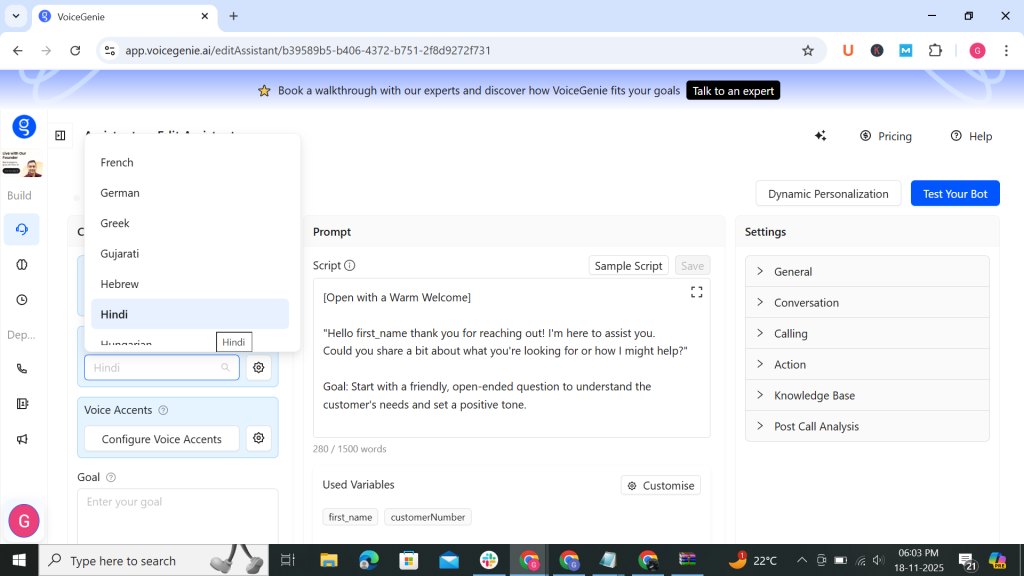
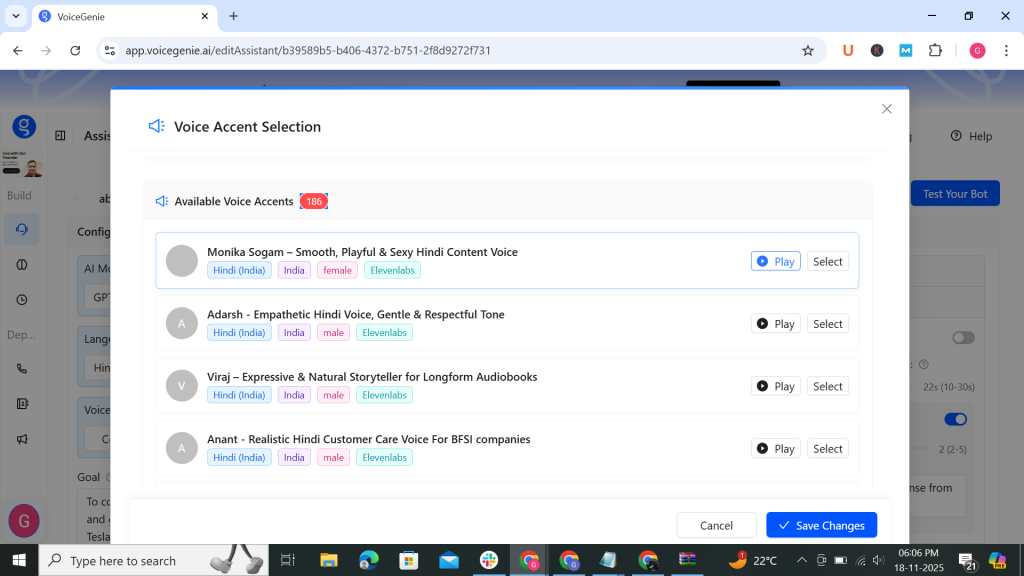
    • The Modern AI Solution: New-age AI voice models now come with “Accent Packs” and are tuned for local tonality. They can handle various accents, understand regional nuances (like how a word in UP differs from one in Bihar), and sound much more human, relatable, and trustworthy.

    3. Handling Complex Queries in Voice (Not Just Text)

    Typing in Hindi is one thing; speaking is another. When a customer calls a business, they expect a quick resolution. Can AI assistants speak Hindi?

    • The Old AI Problem: Many early “Hindi AI” options were just chatbots with a text-to-speech layer. They couldn’t truly understand the spoken question, especially if the user spoke fast, had background noise, or went off-script.
    • The Modern AI Solution: Today, AI agents are voice-first. They use sophisticated Speech-to-Text (STT) and Natural Language Processing (NLP) specifically optimized for Indian languages. They can interpret intent (e.g., recognizing that “Bhaiya, order kab aayega?” means “Where is my order?”) and connect instantly to a backend system (CRM/ERP) to give a real-time, accurate answer.

    The Answers You’ve Been Searching For: AI Hindi Support FAQs

    Let’s address the most common questions people ask when they’re looking for genuinely effective Hindi AI support.

    Q1. “Do AI assistants finally understand Hinglish fluently?”

    A: Yes, the good ones do.

    The biggest breakthrough in AI for the Indian market is the ability to code-switch. A top-tier Hindi AI agent can effortlessly understand a sentence that starts in Hindi and ends in English, or vice-versa. This is essential for sales and customer support, where natural, human-like interaction builds trust.

    Q2. “How can I tell if an AI’s Hindi voice sounds natural or robotic?”

    A: Listen for two things: Tonality and Pace.

    Older AI voices were monotonous. Modern AI uses Neural Speech Synthesis trained on local tonality and human speech patterns.

    • Ask to hear a demo: A good AI voice should have a natural pace, use the correct pronunciation for Indian names/places (e.g., recognizing the difference between ‘Gupta’ and ‘Guptā’), and even convey a friendly tone.
    • Look for features: Check if the AI provider uses advanced text-to-speech models (like those from ElevenLabs or similar high-quality models) that allow for a range of emotional expression.

    Q3. “Can a Hindi AI agent handle complex tasks like scheduling or order booking?”

    A: Absolutely, this is where they shine.

    The new generation of Hindi AI agents are designed to take action, not just reply. They don’t just answer “What is my balance?” but can complete transactions.

    Real-world examples of AI Hindi tasks:

    • Booking: “Mujhe kal subah 10 baje ki meeting book karni hai.” (The AI confirms the time, checks the calendar, and books the slot.)
    • Troubleshooting: “Mera internet kaam nahi kar raha hai.” (The AI guides the user through step-by-step diagnostics.)
    • Data Capture: It can accurately capture Indian data like specific PIN codes, flat numbers, and rupee amounts, even when spoken casually.

    Q4. “What are the key benefits of using a Hindi AI for my business?”

    The impact is massive, especially for businesses serving Tier-2 and Tier-3 cities where English proficiency is lower.

    BenefitExplanationImpact
    24/7 AvailabilityAn AI never sleeps, ensuring no missed calls or waiting lines at midnight.Reduced customer churn and improved satisfaction.
    Cost ReductionAutomates up to 90% of routine queries (like balance checks, order status).Up to a 60% reduction in staffing costs compared to human-only call centers.
    Faster ResolutionThe AI processes data instantly and connects to your backend (CRM/ERP).Query resolution time drops from minutes to seconds.
    Increased SalesPersonalized product recommendations and automated follow-ups in the customer’s preferred language.Better conversion rates, especially in non-metro areas.

    The Future is Now: How to Get Started

    The biggest takeaway here is to look beyond generic AI tools and choose a solution that is purpose-built for the Indian market. You need a voice AI that understands the nuances, the emotion, and the specific needs of a Hindi-speaking customer.

    If you are a business looking to leverage the power of conversational AI to handle sales, customer support, and lead qualification, look for agents that offer:

    1. Hinglish Comprehension
    2. Natural, Human-like Voice with customizable accents
    3. CRM Integration (HubSpot, Salesforce, etc.) for real-time action
    4. Live Meeting Booking capability

    Meet VoiceGenie: Your Fluent Hindi AI Expert

    Imagine an AI agent that doesn’t just talk in Hindi, but thinks in a way that resonates with your customers.

    VoiceGenie is built for this exact purpose. Our AI Voice Agents are specifically trained to handle the complex, mixed-language reality of the Indian consumer. 

    From ‘Hinglish’ comprehension to effortlessly scheduling a follow-up call, VoiceGenie provides a seamless, human-like, and highly intelligent interaction.

    VoiceGenie can:

    • Handle instant follow-up calls in fluent Hindi.
    • Qualify leads and answer complex FAQs 24/7.
    • Talk to customers in 40+ languages globally, including all major Indian languages.
    • And yes, it can simplify the process of booking appointments and demo scheduling via voice commands, straight into your calendar.

    Don’t let language be the barrier between you and your customers anymore. It’s time to experience the power of an AI that truly speaks their language.

    Ready to see our AI speak for itself?

    Stop searching for the solution and start using it.

    Book a Meeting with Our Voice AI Experts Today!

    See a live demo tailored to your business’s unique use case and learn how VoiceGenie can help you reduce operational costs, eliminate long wait times, and engage your customers in natural, fluent Hindi.

    Click Here to Book Your Live Demo with VoiceGenie Experts!

  • Top Voice Agents For Medical Appointment Reminders

    Top Voice Agents For Medical Appointment Reminders

    Stop The Dial Tone Drain: Your Final Decision on the Top Voice Agents for Medical Appointment Reminders

    The phone is ringing off the hook. Your staff is stretched thin, juggling complex patient care with the endless, repetitive task of dialing out appointment reminders. Missed appointments are costing you thousands, and your patients are frustrated by constant voicemails or long hold times.

    If this sounds familiar, you’ve already made the first and most important decision: You need a Voice AI Agent.

    Now comes the crucial, revenue-defining choice: Which voice agent is the right fit for your unique medical practice or healthcare system?

    The market is buzzing with phenomenal technology, but not all AI is created equal—especially when it comes to the highly sensitive, HIPAA-compliant world of healthcare. This is the moment to move past the demos, stop the endless comparison charts, and make your final, confident decision.

    We’ve done the deep-dive, addressing the major queries and pain points business owners like you have. Here are the top 5 Voice AI Agents for medical appointment reminders, with one clear frontrunner that is setting the new standard.

    The Core Problem: Why Your Current System is Failing

    Before we dive into the solutions, let’s quickly acknowledge the elephant in the room. You’re searching for an AI because your current system is likely suffering from one or more of these common failure points:

    • High No-Show Rate: Patients forget. It’s a fact. Generic SMS or IVR reminders are easily missed or ignored.
    • Staff Burnout: Your most valuable resource—your front desk team—is wasting hours on outbound calls instead of focusing on in-office patient care.
    • Inconsistent Patient Experience: Are patients hearing a robotic voice or a human-like, empathetic conversationalist? A poor interaction reflects negatively on your brand.
    • Zero Scalability: You can’t handle unexpected call spikes or grow your practice without hiring more people, creating a costly bottleneck.
    • EHR/PMS Integration Headaches: The system you choose must talk seamlessly with your Electronic Health Record (EHR) or Practice Management System (PMS) to avoid double-booking and data silos.

    The right Voice AI agent will solve all of these problems, moving the administrative burden from human to bot, and transforming your appointment book from a source of stress into a source of revenue.

    The 5 Elite Voice Agents That Will Transform Your Practice

    1. VoiceGenie.ai: The Conversational Champion for Revenue Growth

    Why it’s the Clear No. 1 Choice for a Final Decision:

    VoiceGenie.ai distinguishes itself by focusing squarely on the healthcare-specific outcomes that matter most: maximizing confirmed appointments and minimizing staff workload. 

    Unlike general-purpose AI, VoiceGenie is purpose-built to navigate the complex, multi-turn conversations required voice agent in healthcare —not just confirming an appointment, but also rescheduling, verifying insurance details, and answering pre-appointment FAQs in a single, fluid call.

    User Query AnsweredVoiceGenie.ai’s EdgeWhy This Matters to Your Business
    “Will the voice sound robotic?”Ultra-Realistic & Context-Aware Voice: Utilizes the latest Generative AI models for truly human-like conversation, complete with empathy detection and the ability to handle smart interruptions.Higher patient trust and satisfaction. Patients are more likely to engage with and follow instructions from a natural-sounding voice, leading to a significant reduction in hangups.
    “How will it handle reschedules?”Real-Time Calendar & EHR/PMS Integration: Books, confirms, and reschedules appointments directly into your calendar (Google Calendar, Outlook, EHR/PMS via webhooks/APIs) instantly during the call.Eliminates double-bookings and saves immense staff time. The AI can manage the entire reschedule loop 24/7 without human intervention.
    “Can it scale with my business?”Instant Deployment & High Volume Capacity: Designed to launch quickly and scale immediately, handling thousands of concurrent outbound and inbound calls without performance degradation.You can handle seasonal spikes, new patient campaigns, and practice growth without hiring a single new staff member.
    “What if the patient needs to speak to a human?”Seamless Human Transfer with Context: If a conversation becomes too complex (e.g., a clinical question), the AI transfers the call to a human agent, providing the staff member with a real-time summary of the conversation.Zero patient frustration. The patient never has to repeat themselves, ensuring a smooth, premium experience.

    The VoiceGenie Difference: The platform is engineered to turn a simple reminder into a full patient engagement touchpoint, ensuring not just that the patient shows up, but that all administrative pre-work is completed, making the on-site visit smoother. 

    Their focus on speed of lead/patient outreach is key: cutting response time to seconds, which significantly boosts engagement and booking rates.

    2. Hyro: The Adaptive Communications Specialist

    Hyro focuses on ‘Adaptive Communications,’ positioning itself as a quick-to-deploy solution that can rapidly ingest and understand a healthcare system’s existing knowledge base.

    • Best For: Large healthcare systems or hospitals that need a fast deployment across multiple channels (voice, chat, SMS) and have a massive amount of unorganized knowledge data.
    • Key Feature: Its ability to “plug into” existing data sources and adapt to changes without extensive manual training is a huge plus for large, complex organizations.
    • The Appointment Reminder Angle: Excellent at deflecting or resolving routine calls, including appointment confirmations and FAQs, freeing up human agents.

    3. Amelia (by SoundHound AI): The Enterprise-Grade Conversationalist

    Amelia brings a powerful, enterprise-level platform, leveraging SoundHound AI’s proprietary Automatic Speech Recognition (ASR) technology. This system is designed for high-stakes, multi-step interactions.

    • Best For: Massive health systems already using EHRs like Epic, looking for a deeply integrated, complex-task-handling AI (beyond just reminders, into areas like complex billing and Rx management).
    • Key Feature: Mastery of complex appointment management, integrating with EHRs to handle intricate details like prerequisite testing and pre-appointment questionnaires.
    • The Appointment Reminder Angle: Provides a comprehensive, multi-turn conversational experience that goes far beyond a simple “yes/no” confirmation.

    4. CloudTalk AI Voice Agents (Alex): The Workflow Automation Expert

    CloudTalk’s AI, “Alex,” is notable for its focus on end-to-end workflow automation within the call center. It’s designed to handle a call from start to finish, ensuring conversational context is maintained across multiple interactions.

    • Best For: Mid-sized to large call centers that need strong integration with CRM/EMR systems and a platform that excels at detailed workflow automation (e.g., triggering a follow-up SMS immediately after a reminder call).
    • Key Feature: Excellent at maintaining conversational context, meaning if a patient calls back, the AI remembers the previous interaction, enhancing the personal touch.
    • The Appointment Reminder Angle: Strong workflow automation ensures timely action and follow-ups based on the outcome of the reminder call (e.g., immediate rescheduling or cancellation).

    5. Zocdoc’s Zo: The Patient-First Scheduler

    While Zocdoc is known primarily as a marketplace, its AI voice agent, Zo, represents a strong, patient-focused scheduling engine. Its training focuses heavily on understanding the natural cadence and regional idioms of patient speech.

    • Best For: Practices that prioritize the absolute best patient-side conversational experience and are already part of the Zocdoc ecosystem or value its focus on patient-friendly language.
    • Key Feature: Trained to understand nuances and regional speech patterns, reducing the “misunderstanding” factor that plagues many generic bots.
    • The Appointment Reminder Angle: Handles appointment booking and reminders 24/7 through a natural, conversational flow that prioritizes patient needs and preferences.

    Your Decision Matrix: Which Agent is Best for Your Business?

    Choosing the right Voice AI is not about picking the most expensive or flashiest name; it’s about aligning the technology with your specific pain points and growth strategy. Use this matrix to finalize your choice:

    The Question You Must AskThe Crucial Business ImplicationThe Agent That Wins on This Point
    “How fast can I cut my No-Show rate and recapture lost revenue?”This is the clearest ROI metric. You need a system that ensures a high confirmation rate and instantly reschedules cancellations.VoiceGenie.ai (Focus on 3X More Appointments Booked Automatically)
    “Does it integrate seamlessly with my existing EHR/PMS without a custom build?”Poor integration leads to scheduling errors and data inaccuracies, defeating the purpose of automation.Amelia (Strong, pre-built integration with Epic/Cerner for large systems) & VoiceGenie.ai (Broad integration via APIs/Webhooks for all systems)
    “Will the voice sound human enough to be trusted by my patients?”Patient trust is paramount. A robotic voice will be hung up on, wasting the call.VoiceGenie.ai (Focus on ultra-realistic Generative AI voice with empathy)
    “How quickly can I deploy this solution?”You need relief for your staff now. Months-long implementation is a non-starter.Hyro (Known for rapid knowledge ingestion and deployment) & VoiceGenie.ai (Claiming a 5-minute setup process)
    “Can it handle complex, multi-turn scheduling and verification?”The AI must be able to confirm, verify insurance, and answer basic pre-appointment questions in one go.VoiceGenie.ai and Amelia (Both excel at complex conversational flows)

    The Final Verdict: Why VoiceGenie.ai is Your Destination

    While all five of these agents offer significant improvements over traditional methods, VoiceGenie.ai stands out as the optimal choice for healthcare providers who demand an immediate, measurable impact on their revenue and staff efficiency, without sacrificing patient experience.

    It successfully blends the most human-like conversational experience (preventing hangups) with the deepest, real-time calendar integration (preventing errors), all while keeping a laser focus on the core business goal: Confirmed Appointments and Reduced Staff Workload.

    You are not just buying a reminder service; you are deploying a 24/7 virtual patient engagement specialist that works tirelessly, never gets tired, and never sends a patient to a frustrating voicemail.

    The time for evaluation is over. The time for a decision is now. Every day you delay is another day you are losing potential revenue to a preventable no-show and another hour your valuable human staff is tied to the phone.

    What’s Next? Get Your Questions Answered and Start Automating.

    Choosing the right partner is a big decision, and we understand you may still have specific questions about your unique practice, such as:

    • How does VoiceGenie.ai specifically handle my obscure EHR/PMS integration?
    • What are the exact compliance protocols and security measures?
    • Can the AI be customized with my preferred doctor’s voice or a regional accent?

    We are here to provide the precise, data-backed answers you need to move forward with complete confidence.

    Don’t wait to recapture the revenue lost to missed appointments.

    Book a personalized deep-dive meeting with a VoiceGenie.ai specialist today. Let us show you, live and in-person, how easily we can plug into your system and how quickly you can achieve a measurable ROI.

    [Click Here to Book Your Exclusive VoiceGenie.ai Deep-Dive Session]

    Let’s make sure the next time your phone rings, it’s the sound of a perfectly booked and confirmed appointment.

  • Can AI assistants speak Hindi?

    Can AI assistants speak Hindi?

    Can AI Assistants Speak Fluent Hindi? The Future of Enterprise Voicebots

    Yes, absolutely—they can articulate, translate, and generate coherent Hindi. However, while they are masters of language, they are still students of culture and context.

    Imagine holding a conversation with a genie. Not the brass lamp variety, but a digital entity capable of instant knowledge, seamless communication, and tireless service.

    Now, imagine this genie not just understanding the sterile logic of code, but the warm, vibrant, and incredibly complex fluidity of Hindi

    For enterprises targeting the massive Indian market, the ability of AI assistants to speak Hindi is the ultimate test of the AI revolution.

    It forces us to ask: Is language a predictable set of rules, or is it a living, breathing social contract? 

    To understand how Enterprise SaaS solutions and Hindi voicebots process this language, we must venture into the computational ‘mind’ and explore the conceptual facts that govern their linguistic symphony.

    The Statistical Genius: How AI Learns to Talk Hindi?

    The journey begins not with a dictionary, but with a vast library of probability. Modern AI assistants for business don’t operate on simple “if/then” rules; they are built upon Neural Networks and Deep Learning—computational architectures that loosely mimic the human brain.

    When a model is trained on gargantuan datasets of Hindi text and speech, it does not memorize phrases. Instead, it develops an intuitive, statistical grasp of the language:

    • Language Model: This powerful engine learns the probability of word sequences. If you say, “आज मौसम” (Aaj mausam – Today weather), the model predicts with near-certainty that the next likely word is “कैसा” (kaisa – how). It masters grammar and syntax through sheer statistical exposure.
    • Semantic Mapping: Once the sentence is structured, the AI maps the conceptual meaning (weather, time, inquiry) to its internal capabilities. This process is what allows Hindi voicebots to understand the intent behind the words.

    The result is a fluent, grammatically sound response—a feat of statistical engineering that successfully simulates human conversation.

    The Conceptual Hurdles: Where Hindi Breaks the AI Algorithm

    Despite this immense computational power, Hindi throws up linguistic and cultural challenges that are far more complex than a simple translation layer. 

    These are the fascinating gaps between a machine’s command of language and a human’s mastery of it:

    1. The “Vibes” Problem: Missing Pragmatic Understanding

    Hindi, like many languages of the Indian subcontinent, is deeply dependent on social and cultural context (pragmatics). The same word can carry a completely different meaning based on the speaker’s relationship with the listener.

    • Fascinating Fact: The word “अच्छा” (achha) is a linguistic chameleon. Said quickly and high-pitched, it means “Really?” Said slowly with a falling pitch, it means “I understand/Okay.” The AI, lacking shared human experience, struggles to discern these subtle tonal and emotional cues that are instantly obvious to a human.

    2. The Code-Switching Conundrum: The Reality of Hinglish

    India communicates in Hinglish—a vibrant, fluid reality where Hindi and English are seamlessly blended within the same sentence.

    • Conceptual Fact: Traditional AI assistants struggle with code-switching. When a user says, “Mera order kahan hai?” (Where is my order?), the AI must instantly switch its grammar engine, recognizing the English noun “order” within the Hindi syntactic structure. Overcoming this requires hybrid models that can simultaneously process and predict elements from two different language systems.

    3. Data Scarcity for Nuance and Dialect

    While there is enormous volume of data for Hindi, collecting and meticulously labeling data that captures the language’s true diversity remains a challenge.

    • Informative Fact: The intelligence of any Hindi voicebot is directly proportional to the quality of its training data. To truly master Hindi, the AI needs labeled examples of regional accents, specific dialects, and conversational nuances from across India, which is an enormous, continuous data curation task.

    The Future: Enterprise SaaS Demands Cultural Intelligence

    The future of Hindi-speaking AI is focused on closing the gap between statistical mastery and cultural fluency. For Enterprise SaaS providers, this means building next-generation language models that are:

    • Multimodal: Integrating audio cues and context alongside text for richer interpretation.
    • Personalized: Models that learn an individual user’s preferred language blend, accent, and terminology.
    • Domain Specific: Trained on highly specific industry vocabularies (e.g., banking Hindi vs. e-commerce Hindi) to ensure pinpoint accuracy in automated customer service.

    The journey to an AI that speaks Hindi fluently and naturally is a testament to the profound complexity and beauty of human communication itself.

    Ready to Let Your Business Speak Fluent, Native Hindi?

    If your business needs an AI assistant that actually sounds like a native Hindi speaker—handling code-switching, understanding context, and delivering exceptional customer experience—you need specialized technology. 

    VoiceGenie is a leading Enterprise SaaS provider specializing in high-fidelity, conversational Hindi voicebots trained on real-world Indian dialogue to handle complex customer interactions flawlessly.

    Ready to see customer engagement and efficiency soar with a Hindi voicebot that truly speaks to your audience? 

    Stop losing customers to language barriers. 

    Click here to book a personalized VoiceGenie demo today and unlock the power of conversational Hindi AI!

  • Best AI Emotion-Recognition Models for Conversational Agents 2026

    Best AI Emotion-Recognition Models for Conversational Agents 2026

    In 2026, conversational agents are no longer just about answering queries. They are evolving into intelligent companions that understand not only what users say but also how they feel.

    This is made possible by emotion recognition models — AI systems designed to detect human emotions from voice, text, or facial expressions. For ai voice agents, emotion detection plays a crucial role. It transforms interactions from mechanical exchanges into emotionally aware conversations.

    For SaaS companies offering voice AI solutions, integrating voice emotion recognition app is no longer optional. It’s a key differentiator. Emotion-aware conversational agents improve engagement, customer satisfaction, and even conversion rates.

    This guide explores the for conversational agents in 2026. We will break down how these models work, their benefits, challenges, and how to choose the right one for your SaaS application — with a special focus on VoiceGenie.ai.

    What is Emotion Recognition in Conversational Agents

    Emotion recognition — sometimes called affective computing — is the ability of AI systems to detect and interpret human emotions. For conversational agents, this often means analyzing voice signals to understand feelings such as happiness, frustration, anger, or sadness.

    Why it matters in voice AI

    Human conversations are emotional. Tone, pitch, pace, and word choice all carry emotional cues. Traditional voice assistants respond only to content, ignoring emotional context. Emotion recognition changes that. It makes interactions more natural and empathetic.

    Types of emotions detected

    Emotion recognition models typically identify:

    • Basic emotions — happiness, sadness, anger, fear, surprise, disgust.
    • Complex emotions — frustration, boredom, confusion, excitement.
    • Emotional intensity — subtle differences in expression.

    Where it fits in a voice AI

    In a voice-based conversational agent like VoiceGenie.ai, emotion recognition sits in the AI processing pipeline after speech-to-text conversion. It analyzes:

    • Acoustic features (tone, pitch, speech rate).
    • Linguistic features (word choice, syntax, sentiment).
    • Contextual data (conversation history, user profile).

    This emotional insight allows voice AI to respond with appropriate tone, adapt language, and improve user experience.

    Emotion recognition is now a foundational capability for advanced conversational AI — especially in customer service, healthcare, and education.

    How Emotion Recognition Works in AI Voice Agents

    Emotion recognition in voice agents combines signal processing, machine learning, and contextual analysis.

    Here’s a simplified workflow:

    1. Speech signal acquisition
    2. Feature extraction
      • AI extracts acoustic features such as pitch, tone, volume, speech rate, and pauses.
      • Linguistic features like word choice, sentiment, and syntax are also analyzed.
    3. Emotion classification
      • Extracted features are fed into a trained machine-learning model.
      • The model classifies the emotion into categories (e.g., happy, sad, frustrated).
    4. Contextual refinement
      • The agent uses conversation history, user profile, and situational context to refine detection.
      • This improves accuracy and personalization.
    5. Emotion-based response generation
      • The agent adjusts tone, language, and recommendations based on detected emotion.
      • For example: a frustrated user may get a faster, simpler response; a happy user may receive friendly suggestions.

    Key technologies involved:

    • Deep learning models (RNNs, CNNs, Transformers)
    • Speech emotion recognition (SER) systems
    • Natural language processing (NLP)
    • Multimodal fusion (voice + text + context)

    How do voice agents detect customer emotions and sentiment?

    Modern AI voice agents analyze tone, pace, pauses, and word choice using advanced speech-emotion models. These models identify emotions like frustration, confusion, and excitement within milliseconds — allowing the agent to adjust its tone, empathy level, and flow instantly. This makes every interaction feel more human, personalised, and context-aware. Want to know the exact tech behind this and how it works in real calls? Tap here to explore the full breakdown.

    Benefits of Emotion Recognition in AI Voice Agents

    Integrating advanced providers supporting multilingual and emotion-aware voice models benefits to SaaS voice AI platforms.

    1. Enhanced User Engagement

    Emotion-aware agents can adapt responses to users’ feelings, keeping conversations natural and engaging.

    2. Improved Customer Satisfaction

    Emotion detection allows faster resolution of problems, reducing frustration and increasing loyalty.

    3. Personalized Experiences

    Voice agents can tailor tone, language, and suggestions based on the emotional state of the user.

    4. Better Conversion Rates

    Emotion-sensitive responses can lead to higher engagement and more conversions in sales-driven applications.

    5. Industry-Specific Use Cases

    • Healthcare: Detecting stress or discomfort in patients during teleconsultations.
    • Customer Support: Identifying frustration early to escalate issues.
    • Education: Adapting tutoring tone based on student engagement.

    Challenges in Emotion Recognition for Conversational AI

    Emotion recognition is powerful but comes with technical and ethical challenges.

    1. Accuracy Issues

    • Voice emotion detection accuracy depends on the quality of training data.
    • Models may struggle with overlapping emotions or subtle cues.

    2. Cultural and Linguistic Differences

    • Emotional expression varies across languages and cultures.
    • A model trained for one demographic may perform poorly in another.

    3. Environmental Noise

    • Background noise, microphone quality, and recording conditions can reduce detection accuracy.

    4. Privacy and Ethics

    • Emotion recognition involves sensitive data.
    • Users must be informed and consent to emotional data processing.

    5. Computational Requirements

    • Real-time emotion detection requires robust processing power and optimized algorithms.

    Criteria to Evaluate Emotion Recognition Models

    Choosing the right emotion-recognition model is not just about accuracy. In 2026, it’s about finding a balance between precision, scalability, and adaptability.

    When evaluating models, think beyond just “how well they detect emotions.” Ask yourself — how will this integrate into my voice AI product? Will it work in real time? Can it handle the scale of my user base?

    Here are key factors to consider:

    First, accuracy is vital, but it should be measured in real-world scenarios, not just lab conditions. An emotion model might perform well in a controlled dataset but fail in a noisy call center or in multilingual environments.

    Second, real-time processing is a must. Modern voice agents operate at lightning speed, and a delayed emotional cue can break the conversational flow.

    Third, scalability matters. Your model should be able to handle thousands of simultaneous conversations without latency.

    Language support is another big consideration. In a global SaaS voice platform, emotion models must work across dialects and accents.

    Lastly, integration ease and cost efficiency play a huge role. The best model is the one that can seamlessly plug into your existing architecture without breaking your budget.

    Best AI Emotion Recognition Models in 2026

    The landscape of emotion recognition is evolving fast. Several models stand out for their accuracy, flexibility, and innovation. Let’s explore the bfsi companies in 2026 — with a special spotlight on VoiceGenie.ai’s own proprietary model.

    OpenAI’s Emotion Recognition API offers cutting-edge sentiment analysis powered by large-scale deep learning. It delivers nuanced emotional detection and integrates easily with existing AI workflows. However, it comes with high compute costs and limited language diversity.

    Affectiva, part of Smart Eye, focuses on multimodal emotion detection, blending voice and facial cues. It’s ideal for industries like automotive and healthcare, but requires robust hardware for optimal performance.

    Beyond Verbal Analytics specializes in voice-based emotional analytics. Their strength lies in detecting emotional intensity and subtle mood shifts, making it perfect for call centers. The trade-off — it lacks strong linguistic analysis compared to others.

    IBM Watson Tone Analyzer shines in enterprise environments. Its emotional and linguistic analysis capabilities allow deep contextual insights. It works best for structured data but is not optimized for raw, noisy voice inputs.

    Microsoft Azure Emotion API provides a versatile option, with strong integration into Microsoft ecosystems. It works well for developers looking for a scalable enterprise-ready solution, though customization can be challenging.

    VoiceGenie.ai’s Proprietary Emotion Model takes emotion detection to a new level. Designed specifically for voice agents, it is built for real-time accuracy, multilingual support, and low-latency performance. The model adapts to cultural nuances and supports diverse dialects, making it a perfect choice for global conversational AI applications. VoiceGenie.ai not only detects emotion but adapts the voice tone and dialogue dynamically — creating human-like, emotionally aware conversations.

    Comparison Table of Top Emotion Recognition Models

    To make the selection process easier, let’s visualize how these models stack up. Here’s a simplified comparison:

    ModelAccuracyLanguage SupportReal-Time ProcessingIntegration EaseCostIdeal Use Case
    OpenAI Emotion APIHighMediumMediumHighHighAdvanced sentiment analysis
    AffectivaMediumHighMediumMediumMedium-HighMultimodal detection (voice + face)
    Beyond VerbalHighLowHighMediumMediumCall center analytics
    IBM Watson Tone AnalyzerMediumHighLowHighMediumEnterprise insights
    Microsoft Azure Emotion APIMedium-HighMedium-HighHighHighMediumScalable enterprise applications
    VoiceGenie.aiHighHighHighHighMediumReal-time multilingual voice AI

    This table is not just about features — it’s about what fits your product needs best. For voice-based SaaS, where real-time adaptation and emotional awareness matter, VoiceGenie.ai offers a powerful edge.

    Implementing Emotion Recognition in Your Conversational AI

    Integrating emotion recognition into your voice AI is not just a technical task — it’s a strategic step that transforms user experience. The goal is to make your conversational agent not just responsive, but emotionally aware.

    Implementation starts with selecting the right model. Once chosen, integration involves feeding the model with live voice data, processing it in real time, and applying the emotional cues to guide responses.

    For SaaS platforms like VoiceGenie.ai, the process is designed to be smooth:

    • API or SDK Integration: Many emotion recognition models, including VoiceGenie.ai’s, provide APIs that allow developers to plug them directly into voice AI workflows. This eliminates the need for building models from scratch.
    • Real-Time Emotion Processing: The system captures voice inputs, analyzes them instantly, and outputs emotional insights. This enables the agent to adjust tone, phrasing, or escalation strategies in real time.
    • Customization: Emotion recognition models should be adaptable to your use case. For example, in a healthcare chatbot, the model might prioritize detecting stress and discomfort. In a sales assistant, it might detect excitement or hesitation.
    • Testing & Feedback Loops: Continuous testing is critical. Real-world conversations vary greatly, so monitoring performance and feeding back data for model retraining ensures accuracy improves over time.

    For developers, this means designing a pipeline where the voice AI constantly learns and adapts. For product managers, it means aligning emotion recognition with business goals like higher engagement, customer satisfaction, and conversions.

    With VoiceGenie.ai, integration is simplified. Its emotion-recognition model is pre-trained for conversational contexts, supports multiple languages, and works efficiently even under noisy conditions — making it ideal for global SaaS voice agents.

    Future Trends in AI Emotion Recognition (2026)

    The future of emotion recognition is both exciting and transformative. By 2026 and beyond, the technology will become even more integrated into the conversational AI landscape.

    Here’s what to expect:

    • Multimodal Emotion Recognition: Future systems will combine voice, text, facial expression, and physiological signals for richer emotional understanding. This means conversational agents will have a more human-like emotional intelligence.
    • Context-Aware Emotion AI: Emotion detection will incorporate more context — user history, location, conversation purpose — to refine accuracy and relevance.
    • Emotion Personalization: Voice agents will adapt to individual user preferences over time. If a user prefers a calm tone or a more energetic style, the agent will adjust automatically.
    • Ethical Emotion AI: Privacy and consent will be at the forefront. AI developers will need to ensure emotional data is processed securely, ethically, and transparently.
    • Emotion Recognition in Edge Computing: Models will increasingly run on devices rather than cloud servers, enabling faster processing and preserving privacy.
    • Integration with Human-AI Collaboration: Emotion detection will empower hybrid human-AI workflows. In customer support, for example, AI will detect frustration and escalate to a human agent instantly.

    VoiceGenie.ai is already working toward these trends. Its roadmap includes deeper multimodal capabilities and context-aware emotion recognition, making it one of the most advanced platforms for voice-based SaaS applications.

    Emotion recognition is no longer a luxury feature — it’s becoming an expectation for conversational AI. By staying ahead of these trends, SaaS providers can deliver truly human-like, emotionally intelligent experiences.

    Conclusion

    Emotion recognition is no longer an emerging feature — it has become a defining capability for conversational AI in 2026.

    For SaaS voice AI providers, emotion detection is a gateway to deeper engagement, richer user experiences, and stronger customer relationships. It transforms interactions from transactional exchanges into emotionally intelligent conversations.

    Choosing the right emotion-recognition model is critical. Accuracy, real-time processing, scalability, language support, and ease of integration are all factors that influence success. Models like OpenAI’s API, Affectiva, Beyond Verbal, IBM Watson, and Microsoft Azure each bring unique strengths. However, VoiceGenie.ai’s proprietary emotion-recognition model stands out with its combination of multilingual support, real-time adaptation, and cultural nuance detection.

    For SaaS businesses building or enhancing voice agents, investing in emotion recognition is a strategic move. It’s not just about keeping up with technological advances — it’s about creating conversational AI that truly understands and connects with users.

    The future is emotion-aware, and the time to integrate is now.

    Frequently Asked Questions (FAQ)

    Q1. What is emotion recognition in AI?
    It’s the ability of AI to detect and interpret human emotions from voice, text, or facial cues.

    Q2. Why is emotion recognition important for voice AI?
    It makes conversations more natural, empathetic, and personalized.

    Q3. Which model is best for emotion detection in 2026?
    VoiceGenie.ai’s model leads with real-time, multilingual, and context-aware detection.

    Q4. Can emotion recognition work in noisy environments?
    Yes — with advanced models like VoiceGenie.ai that are noise-optimized.

    Q5. Is emotion detection safe and ethical?
    Yes — when users are informed and data is handled with strict privacy measures.

  • How to Measure ROI of Enterprise AI Voice Automation?

    How to Measure ROI of Enterprise AI Voice Automation?

    Enterprises today are investing heavily in call centers, yet many struggle with inefficiencies, long wait times, and high operational costs. 

    AI voice automation has emerged as a game-changer, helping organizations handle routine queries, reduce human errors, and ensure round-the-clock customer engagement.

    But implementing AI is only half the battle—understanding its impact on your business is equally important. Measuring the ROI of AI voice automation enables enterprises to quantify cost savings, efficiency gains, and improved customer satisfaction. 

    By tracking the right metrics, companies can justify investments, optimize AI performance, and scale automation confidently.

    In this blog, we will explore how enterprises can measure their AI voice automation ROI, using cost, efficiency, and customer metrics, along with a practical framework backed by real-world examples.

    What is ROI in AI Voice Automation?

    ROI, or Return on Investment, is a key indicator of the value a business gains from a particular investment. In the context of enterprise AI voice automation, ROI measures the benefits—both tangible and intangible—that AI brings to your call center operations.

    Tangible Benefits:

    • Cost Savings AI Call Center: Reduced labor costs, fewer overtime hours, and lower training expenses.
    • Increased call handling efficiency and productivity.
    • Reduced call abandonment rates and shorter wait times.

    Intangible Benefits:

    • Enhanced customer experience and satisfaction.
    • Improved employee productivity as agents focus on complex tasks.
    • Compliance risk reduction in regulated industries (HIPAA, PCI).

    By combining these factors, enterprises can calculate enterprise AI ROI and understand how AI voice agents contribute to operational excellence and overall business growth.

    Key Metrics to Measure ROI

    Measuring the ROI of AI voice automation requires tracking the right metrics that capture both cost efficiency and customer impact. Here are the core areas enterprises should focus on:

    1. Cost Savings

    AI voice agents reduce the need for additional human agents, cut overtime, and lower training costs. Tracking cost savings can be done by comparing:

    • Total labor cost before AI implementation.
    • Total labor cost after AI implementation.
    • Savings per 1,000 calls handled by AI.

    Example: A call center handling 10,000 calls monthly might save $25,000 by automating routine queries with AI voice agents.

    2. Efficiency & Productivity

    Efficiency metrics indicate how well AI supports enterprise operations:

    • Average call handling time.
    • First-call resolution rate.
    • Call abandonment rate.

    Example: If AI agents handle simple queries 40% faster than humans, employees can focus on complex tasks, improving overall productivity.

    3. Customer Experience & Satisfaction

    Customer metrics capture the indirect ROI of AI:

    • CSAT (Customer Satisfaction) score.
    • NPS (Net Promoter Score).
    • Reduced wait and resolution times.

    Example: An enterprise deploying AI voice agents may see a 15% increase in CSAT scores, which translates into higher retention and long-term revenue growth.

    Step-by-Step ROI Framework

    To systematically measure enterprise AI ROI, follow this five-step framework:

    1. Identify Baseline Metrics – Record current call center performance in cost, efficiency, and customer satisfaction.
    2. Deploy AI Voice Agents for a Pilot – Implement AI for a subset of calls to measure impact without disrupting operations.
    3. Track Key Metrics – Collect data on cost savings, efficiency improvements, and customer satisfaction during the pilot.
    4. Calculate ROI – Use this formula:

    ROI (%) = (Net Savings (Cost + Productivity + Customer Value) / Investment in AI) × 100

    Example: If the pilot saves $50,000 in costs and the investment was $20,000, the ROI = 150%.

    1. Iterate & Scale – Optimize AI call flows based on insights and expand automation across the enterprise.

    This structured approach ensures enterprises can quantify the ROI AI voice automation delivers and make informed decisions about scaling AI initiatives.

    Real Enterprise Examples

    Understanding how AI voice automation impacts real businesses helps illustrate measurable ROI. Here are some examples:

    • Company A: A multinational enterprise implemented AI voice agents for after-hours calls. By automating 60% of routine queries, they reduced labor costs by $30,000 monthly and improved first-call resolution by 20%.
    • Company B: A financial services firm used AI agents to handle payment inquiries. The pilot program showed a 25% reduction in call abandonment rates and a 15% improvement in CSAT scores.
    • Company C: A healthcare provider deployed AI voice automation to handle appointment scheduling. This freed human agents to focus on complex patient calls, reducing average call handling time by 35% and generating an estimated ROI of 180% in the first six months.

    These examples show that measuring enterprise AI ROI isn’t just about cost savings—it also includes efficiency gains, better customer experiences, and increased employee productivity.

    Common Challenges & Pitfalls

    Even with AI voice automation, enterprises may face challenges that affect ROI if not managed carefully:

    1. Overestimating AI Capabilities – Not all calls can be fully automated. Setting realistic expectations is key.
    2. Tracking the Wrong Metrics – Focusing only on cost savings without considering customer satisfaction or efficiency can give a skewed ROI picture.
    3. Ignoring Indirect ROI – Benefits like improved employee productivity, customer retention, and risk reduction must also be considered.
    4. Insufficient Pilot Testing – Skipping a pilot phase can lead to poor adoption and inaccurate ROI calculations.

    By recognizing these pitfalls, enterprises can ensure their AI voice automation investment delivers maximum value.

    Best Practices for Maximizing ROI

    To achieve the highest return from AI voice automation, enterprises should follow these detailed best practices:

    • Start with Pilot Programs:
      Begin with a small-scale deployment to test AI capabilities. Measure metrics such as call resolution rates, handling times, and customer satisfaction before scaling to the entire enterprise.
    • Align AI KPIs with Business Objectives:
      Ensure the key performance indicators of AI voice agents support strategic goals. For example, reducing average call handling time aligns with cost savings, while improving CSAT scores supports customer retention objectives.
    • Continuously Monitor Performance:
      Use dashboards to track AI metrics in real-time. Regular monitoring allows for quick adjustments to workflows, helping maximize enterprise AI ROI.
    • Integrate AI with Human Agents:
      AI should handle repetitive tasks while humans manage complex interactions. This hybrid approach improves efficiency and maintains high-quality customer experiences.
    • Leverage Feedback Loops:
      Collect feedback from both customers and human agents to fine-tune AI performance. Adjust scripts, responses, and call flows to enhance accuracy and customer satisfaction over time.
    • Measure Both Tangible and Intangible Benefits:
      Tangible metrics include labor cost savings and efficiency gains, while intangible metrics include employee productivity, customer loyalty, and risk reduction. Tracking both ensures a comprehensive view of ROI AI voice automation.

    By following these best practices, enterprises can maximize the impact of AI voice automation, achieve measurable enterprise AI ROI, and build a scalable, efficient, and customer-centric call center ecosystem.

    Conclusion

    Measuring the ROI of AI voice automation is essential for enterprises aiming to optimize call center operations and maximize value from technology investments. 

    While cost savings are the most visible metric, true ROI encompasses efficiency gains, improved customer satisfaction, enhanced employee productivity, and reduced compliance risks.

    By following a structured approach—tracking key metrics, running pilot programs, and continuously optimizing AI workflows—enterprises can accurately quantify enterprise AI ROI and make informed decisions about scaling automation. 

    Real-world examples demonstrate that AI voice agents not only reduce operational costs but also enhance overall business performance, making them a critical component of modern call centers.

    Investing in AI voice automation is not just about replacing human agents—it’s about creating smarter, faster, and more customer-centric operations. With the right measurement framework, enterprises can unlock the full potential of AI and realize a significant, sustainable ROI.

    FAQ

    Q1: What is AI voice automation ROI?
    A: It measures the financial and operational benefits of using AI voice agents, including cost savings, efficiency, and customer satisfaction.

    Q2: How do enterprises calculate cost savings?
    A: Compare pre-AI costs (labor, overtime, training) with costs after AI deployment, including efficiency gains.

    Q3: Which metrics matter most?
    A: Average call handling time, first-call resolution, call abandonment, CSAT, NPS, and labor cost savings.

    Q4: How does AI improve customer satisfaction?
    A: By providing fast, accurate responses and freeing humans to handle complex queries, improving CSAT and NPS.

    Q5: Best practices to maximize ROI?
    A: Start with pilots, align KPIs with goals, monitor performance, integrate AI with humans, and use feedback loops.

  • How Enterprises Can Automate After-Hours Calls with AI Voice Agents?

    How Enterprises Can Automate After-Hours Calls with AI Voice Agents?

    Customers today expect help anytime they reach out, even after business hours. But most companies struggle to provide support at night or on weekends. 

    Missed calls, delayed responses, and frustrated customers are common problems that can hurt your brand and sales.

    This is where AI voice agents come in. These smart systems can handle calls, answer questions, and even capture important information from customers—without needing a human agent to be awake. 

    With tools like VoiceGenie, businesses can offer reliable 24/7 support, making sure every customer interaction is answered quickly, even after hours.

    By automating after-hours calls, enterprises don’t just reduce missed calls—they create a smoother, faster, and more professional experience for their customers, any time of the day or night.

    Why After-Hours Support Is a Challenge

    Providing support outside normal working hours is harder than it sounds. Some common challenges include:

    • Limited staff availability: It’s tough to have people available at night or on weekends, and hiring extra staff adds costs.
    • Higher expenses: Night shifts, overtime, and extra training make after-hours support expensive.
    • Missed opportunities: Calls that aren’t answered immediately can lead to lost sales or unhappy customers.
    • Slow resolutions: Customers with urgent questions often have to wait until the next day, which affects satisfaction.
    • Inconsistent service: Late-hour teams may not provide the same quality or accuracy as regular support staff.

    This is why more enterprises are turning to AI-driven solutions to manage calls outside office hours. AI voice agents can answer questions instantly, guide customers, and pass on important issues to human agents—keeping operations smooth while improving the customer experience.

    How AI Voice Agents Solve After-Hours Support Challenges

    AI voice agents are changing the way enterprises handle customer calls outside business hours. Unlike traditional support, these agents are always available and can manage multiple calls at once. Here’s how they make a difference:

    • Instant responses: Customers don’t have to wait for a human agent. AI voice agents answer queries immediately, even at midnight.
    • Handling routine questions: Common requests like store hours, order status, or account information can be resolved without human intervention.
    • Routing complex issues: When a question is too complicated, AI agents can collect details and schedule a callback or forward the call to the right team.
    • Integration with systems: AI agents can connect to your CRM, helpdesk, or VoIP systems, so they have access to customer data and can provide accurate information.
    • Learning and improving: Modern AI systems like VoiceGenie get smarter over time, understanding customer queries better and responding more naturally.

    With this approach, enterprises don’t just answer calls—they provide a professional, consistent, and helpful experience around the clock.

    Benefits of Automating After-Hours Calls

    Implementing AI voice agents for after-hours support brings clear advantages for businesses:

    • Never miss a call: Every customer gets a response, reducing the risk of lost leads or opportunities.
    • Cost savings: No need to staff expensive night shifts—AI agents work 24/7 without extra pay.
    • Better customer satisfaction: Instant responses and consistent service make customers feel valued.
    • Focus on complex tasks: Human staff can spend time on more important or specialized work, instead of routine questions.
    • Scalability: AI agents can handle a sudden spike in calls without delays, ensuring smooth service even during busy times.

    By combining AI voice agents with a smart after-hours strategy, enterprises can improve efficiency, save money, and maintain a strong relationship with their customers—even when humans aren’t available.

    Practical Implementation: Automating After-Hours Calls with VoiceGenie

    Setting up after-hours call automation doesn’t have to be complicated. With VoiceGenie, enterprises can quickly deploy AI voice agents to handle customer calls smoothly. Here’s a simple approach:

    1. Identify call patterns: Analyze your after-hours call data to see peak times, common queries, and urgent issues.
    2. Create AI scripts: Prepare conversational flows for FAQs, appointment scheduling, order tracking, and escalation to human agents when needed.
    3. Integrate with systems: Connect VoiceGenie to your CRM, VoIP, or helpdesk tools so it can access customer details and update records in real time.
    4. Monitor and optimize: Track performance metrics like call resolution time, missed calls, and customer satisfaction to continuously improve responses.

    This step-by-step approach ensures that your AI voice agent can handle calls effectively, giving customers instant support even after hours.

    Example Scenario: How Enterprises Benefit from After-Hours Automation

    Consider a mid-sized e-commerce company struggling with night-time customer inquiries. Before automation, many calls went unanswered, leading to lost sales and frustrated customers.

    After implementing VoiceGenie:

    • Missed calls dropped by 80% as the AI agent handled all routine queries.
    • Customer satisfaction improved, with instant responses for order tracking and product questions.
    • Staff focus shifted to high-value tasks, like processing orders and resolving complex complaints, instead of answering repetitive calls.

    This example shows how enterprise AI after-hours solutions not only improve service but also free human staff to focus on tasks that matter most.

    The Future of After-Hours Support

    AI voice agents are no longer just a convenience—they are becoming a standard for enterprise customer service. In the near future:

    • AI will handle more complex queries with advanced natural language understanding.
    • Integration with analytics tools will allow businesses to predict customer needs and offer proactive support.
    • AI agents will personalize interactions based on customer history, creating a more human-like experience even without a live agent.

    Enterprises that adopt AI-powered night shift call automation now will be better positioned to meet customer expectations, reduce costs, and stay competitive in an always-on world.

    Conclusion

    After-hours customer support is a challenge for many enterprises, but it doesn’t have to be. By using AI voice agents like VoiceGenie, businesses can offer 24/7 support, ensure no call goes unanswered, and improve overall customer satisfaction.

    Implementing after-hours call automation not only reduces missed opportunities but also lowers operational costs and allows human staff to focus on high-value tasks. With enterprise AI after-hours solutions, companies can maintain seamless communication with their customers, anytime, day or night.

    Investing in night shift call automation today ensures your enterprise stays responsive, competitive, and customer-focused in an always-on world.

    Frequently Asked Questions (FAQs)

    Q1: Can AI voice agents handle complex customer queries after hours?
    A1: Yes. While AI voice agents excel at routine questions, they can also collect necessary details and escalate complex issues to human agents efficiently.

    Q2: How does after-hours call automation integrate with existing systems?
    A2: Solutions like VoiceGenie connect seamlessly with CRM, helpdesk, and VoIP systems, ensuring accurate customer data and smooth call routing.

    Q3: Will automating after-hours calls save money for enterprises?
    A3: Absolutely. AI voice agents work 24/7 without overtime or night shift costs, reducing staffing expenses while improving service.

    Q4: Which industries benefit most from enterprise AI after-hours support?
    A4: Retail, e-commerce, healthcare, financial services, and IT support are just a few industries where AI voice agent 24/7 support significantly improves customer experience.

  • How to Integrate AI Voice Agents with Enterprise VoIP Solutions (Talkdesk, Five9, NICE)

    How to Integrate AI Voice Agents with Enterprise VoIP Solutions (Talkdesk, Five9, NICE)

    In today’s fast-paced business environment, enterprises handle thousands of calls daily. Managing these calls efficiently while ensuring a high-quality customer experience is no easy task. This is where AI voice agent VoIP integration comes in.

    By connecting advanced AI voice agents like VoiceGenie with leading VoIP platforms such as Talkdesk, Five9, and NICE, businesses can automate routine calls, streamline workflows, and reduce the burden on human agents. 

    Imagine your team being able to focus on high-value interactions while AI handles appointment reminders, order confirmations, or after-hours inquiries—this is the transformative power of AI-driven call automation.

    With the growing demand for smarter call centers, understanding how to integrate AI voice agents with enterprise VoIP solutions is no longer optional—it’s a competitive necessity.

    Why Enterprises Need AI Voice Integration with VoIP

    Integrating AI voice agents with VoIP platforms offers a host of benefits for enterprises, from cost savings to operational efficiency. Here’s why businesses are adopting this approach:

    1. Reduce Call Center Costs
      AI voice agents can handle a large volume of routine calls, freeing human agents to focus on complex queries. This reduces staffing costs and increases overall productivity.
    2. Enhance Customer Experience
      With 24/7 availability, AI voice agents ensure that customers are never left waiting. Whether it’s scheduling appointments, tracking orders, or providing basic support, automated calls improve response times and customer satisfaction.
    3. Streamline Workflows
      By integrating with platforms like Talkdesk AI voice, Five9 AI voice, and NICE AI voice automation, enterprises can create seamless workflows that automatically route calls, log interactions, and trigger follow-ups.
    4. Automate Repetitive Tasks
      From reminders to survey calls, repetitive tasks can be fully automated, reducing human error and improving consistency.
    5. Data-Driven Insights
      AI voice integration enables enterprises to capture detailed call data, which can be analyzed to improve operations, optimize staffing, and enhance customer engagement.

    In short, AI voice agent VoIP integration is the bridge between operational efficiency and an enhanced customer experience. Enterprises that adopt this approach gain both scalability and measurable ROI.

    Overview of Leading VoIP Platforms

    Integrating AI voice agents effectively requires understanding the capabilities of major enterprise VoIP solutions. Here’s a closer look at Talkdesk, Five9, and NICE, and how they enable AI-powered automation.

    3.1 Talkdesk

    Talkdesk is a cloud-based call center platform known for its scalability and ease of integration. With Talkdesk AI voice, enterprises can:

    • Automate routine customer interactions like appointment scheduling and follow-ups.
    • Integrate with CRM systems to provide personalized call experiences.
    • Monitor and analyze call performance in real time.

    Integrating VoiceGenie with Talkdesk allows enterprises to offload repetitive calls, streamline workflows, and provide 24/7 customer support without additional staffing costs.

    3.2 Five9

    Five9 is a popular choice for contact centers looking to enhance efficiency with AI. With Five9 AI voice capabilities, businesses can:

    • Automate outbound campaigns for sales or customer outreach.
    • Enable intelligent call routing to human agents when complex queries arise.
    • Capture detailed call analytics for performance optimization.

    By integrating VoiceGenie with Five9, enterprises can ensure that routine tasks—such as order confirmations, reminders, and surveys—are handled seamlessly, allowing human agents to focus on high-value interactions.

    3.3 NICE inContact

    NICE offers advanced AI voice automation designed for large-scale enterprise operations. NICE AI voice automation enables:

    • Multi-channel customer engagement with voice, chat, and messaging.
    • Real-time sentiment analysis for personalized customer interactions.
    • Automated reporting and compliance tracking.

    VoiceGenie’s integration with NICE helps enterprises automate high-volume calls while maintaining quality and compliance, improving efficiency across departments.

    Step-by-Step Guide to Integrating AI Voice Agents with VoIP

    Integrating AI voice agents like VoiceGenie with enterprise VoIP solutions can seem complex, but a structured approach makes it manageable. Here’s a step-by-step guide:

    Step 1: Assess Your Current Call Workflows

    • Map out how calls flow within your enterprise.
    • Identify repetitive tasks and opportunities for AI automation.

    Step 2: Choose AI Voice Features

    • Select VoiceGenie capabilities suitable for your business, such as outbound calls, IVR automation, or support ticket handling.

    Step 3: Configure Integration

    • Use APIs or native integrations available in Talkdesk, Five9, or NICE to connect VoiceGenie.
    • Ensure secure authentication and compliance with enterprise policies.

    Step 4: Map Call Flows and Triggers

    • Define which calls are automated and which require human intervention.
    • Configure triggers for follow-ups, escalations, or notifications.

    Step 5: Test AI Voice Responses

    • Conduct pilot tests with limited call volumes.
    • Refine VoiceGenie’s natural language understanding for accuracy and customer friendliness.

    Step 6: Monitor and Optimize

    • Track KPIs such as call duration, resolution rates, and customer satisfaction.
    • Adjust call scripts, workflows, or integration settings based on insights.

    Benefits of AI Voice Integration for Enterprises

    Integrating VoiceGenie with platforms like Talkdesk, Five9, and NICE brings measurable advantages for enterprises:

    1. Reduced Call Abandonment Rates
    • AI handles high call volumes efficiently, minimizing wait times and abandoned calls.
    1. Improved Customer Satisfaction
    • 24/7 availability and personalized responses enhance the overall customer experience.
    1. Reclaimed Human Agent Hours
    • Human agents can focus on complex tasks while AI handles routine calls.
    1. Scalability
    • Handle seasonal spikes or large call campaigns without hiring additional staff.
    1. Compliance and Security
    • Maintain HIPAA, PCI, and other regulatory compliance automatically through structured workflows and secure call handling.
    1. Data-Driven Insights
    • AI integration provides detailed analytics for better decision-making, workflow improvements, and resource allocation.

    By leveraging AI voice agent VoIP integration, enterprises not only increase efficiency but also strengthen customer trust and operational agility.

     Common Challenges & How to Overcome Them

    While AI voice agent VoIP integration offers significant advantages, enterprises may face some common challenges during implementation. Here’s how to tackle them:

    1. Compatibility Issues
    • Different VoIP platforms have unique APIs and integration requirements.
    • Solution: Use VoiceGenie’s pre-built connectors for Talkdesk AI voice, Five9 AI voice, and NICE AI voice automation, or leverage secure API endpoints for seamless integration.
    1. Training the AI for Enterprise-Specific Language
    • Industry-specific terms or customer accents may reduce AI accuracy.
    • Solution: Provide VoiceGenie with training data, call scripts, and sample interactions to improve natural language understanding.
    1. Security and Compliance Concerns
    • Enterprises must comply with regulations such as HIPAA or PCI DSS.
    • Solution: Configure encrypted communication channels and role-based access within the VoIP platform and AI agent.
    1. Change Management
    • Resistance from staff can slow adoption.
    • Solution: Educate teams about how AI automates repetitive tasks while empowering them to focus on high-value work.

    By anticipating these challenges, enterprises can achieve smooth implementation and maximize the benefits of AI voice automation.

    Real-World Examples / Case Studies

    Seeing integration in action helps enterprises visualize ROI and operational improvements. Here are a few examples:

    Example 1: Talkdesk + VoiceGenie

    • A retail enterprise automated order confirmations and appointment reminders.
    • Result: Reduced human agent workload by 35% and improved customer response time by 50%.

    Example 2: Five9 + VoiceGenie

    • A financial services firm automated outbound survey and support calls.
    • Result: Increased survey completion rates and allowed agents to focus on complex inquiries.

    Example 3: NICE + VoiceGenie

    • A healthcare provider implemented automated follow-up calls post-consultation.
    • Result: Improved patient engagement and ensured compliance with HIPAA regulations.

    These real-world integrations demonstrate how Talkdesk AI voice, Five9 AI voice, and NICE AI voice automation can streamline enterprise call operations while improving efficiency and customer satisfaction.

    Measuring ROI of AI Voice Integration

    Enterprises need to quantify the benefits of AI voice agent VoIP integration. Key metrics to monitor include:

    1. Call Handling Time: Compare average call duration before and after AI integration.
    2. Agent Hours Saved: Track how many hours human agents reclaim for complex tasks.
    3. Customer Satisfaction (CSAT) & NPS: Evaluate improvements in customer experience and loyalty.
    4. Cost Reduction: Calculate savings from reduced staffing needs and faster call resolution.
    5. Call Volume and Scalability: Measure how well AI handles spikes in call traffic without performance drops.

    By monitoring these KPIs, enterprises can not only justify the investment in AI integration but also continuously optimize workflows to achieve greater efficiency.

    Conclusion

    Integrating AI voice agents like VoiceGenie with enterprise VoIP solutions such as Talkdesk, Five9, and NICE is no longer just a futuristic idea—it’s a practical strategy for improving efficiency, reducing costs, and enhancing customer experience.

    By leveraging AI voice agent VoIP integration, enterprises can:

    • Automate routine calls and repetitive tasks.
    • Provide 24/7 customer support.
    • Free up human agents for high-value interactions.
    • Gain actionable insights through call analytics.

    Next Steps for Enterprises:

    1. Assess current call workflows and identify automation opportunities.
    2. Choose the right AI voice agent features tailored to your enterprise needs.
    3. Set up secure integration with your VoIP platform.
    4. Monitor KPIs and optimize AI call performance.
    5. Scale the integration across departments for maximum ROI.

    With VoiceGenie, enterprises can seamlessly integrate AI-powered voice automation with their existing VoIP systems, transforming call operations while maintaining security and compliance.

    FAQs

    Q1: What is AI voice agent VoIP integration?
    A: It’s the process of connecting AI-powered voice agents like VoiceGenie to enterprise VoIP platforms (Talkdesk, Five9, NICE) to automate calls, streamline workflows, and improve efficiency.

    Q2: Can VoiceGenie integrate with Talkdesk, Five9, and NICE without coding?
    A: Yes. VoiceGenie offers pre-built connectors and API integrations for seamless setup with minimal technical effort.

    Q3: How long does it take to implement AI voice automation in an enterprise?
    A: Integration typically takes a few weeks, depending on call volume, workflows, and customization requirements.

    Q4: What are the measurable benefits of AI voice agent VoIP integration?
    A: Enterprises can expect reduced call handling times, increased agent productivity, higher customer satisfaction, and cost savings.

    Q5: How secure is AI voice integration with enterprise VoIP platforms?
    A: VoiceGenie ensures encrypted communication, compliance with HIPAA, PCI, and enterprise security policies, making AI voice automation secure for sensitive operations.

  • The Role of Speech Recognition, TTS, NLP in Modern AI Voice Agents

    The Role of Speech Recognition, TTS, NLP in Modern AI Voice Agents

    The world of customer interaction is evolving at lightning speed. Businesses no longer rely solely on human agents to handle every call or query—AI voice agents are taking the front seat. These intelligent systems not only provide 24/7 support but also deliver consistent, personalized, and efficient conversations with users.

    At the core of modern AI voice agents are three transformative technologies: speech recognition AI, text-to-speech (TTS), and natural language processing (NLP). Each plays a critical role in enabling machines to understand, process, and respond to human language in ways that feel natural and intuitive.

    In this article, we explore how these three pillars work together to make voice agents human-like, contextual, and scalable, and how products like VoiceGenie are leveraging these technologies to redefine the future of voice-driven interactions.

    What is Speech Recognition AI?

    Speech recognition AI is the technology that allows computers to understand spoken language by converting it into text. It forms the foundation of any AI voice agent, enabling the system to “listen” to user queries and extract actionable meaning.

    Modern speech recognition is no longer limited to clear, slow speech. Advanced models can handle different accents, dialects, and even background noise, ensuring accurate understanding in real-world scenarios. This capability is essential for providing seamless, human-like interactions.

    For example, when a user calls a customer support line and asks, “What’s my account balance?”, speech recognition AI captures these words accurately, which allows the system to process the request instantly.

    VoiceGenie leverages cutting-edge speech recognition AI that can handle multi-accent inputs and noisy environments, ensuring that conversations remain smooth and natural regardless of where the user is speaking from.

    Text-to-Speech (TTS): Giving Voice to AI

    Text-to-Speech (TTS) technology transforms written text into natural, human-like speech, enabling AI voice agents to communicate with users audibly. While early TTS systems sounded robotic and monotone, modern advancements allow AI to deliver intonation, rhythm, and expression, creating conversations that feel much closer to interacting with a human.

    TTS is crucial not only for user engagement but also for building trust. A clear, expressive voice can make users feel understood and valued, increasing satisfaction and retention. In applications like automated support lines or enterprise voice assistants, TTS ensures that responses are not just accurate, but also pleasant and relatable.

    VoiceGenie Insight: VoiceGenie’s TTS engine is designed to produce expressive, context-aware speech. It can modulate tone based on the conversation’s intent—whether answering a query, providing guidance, or delivering notifications—making interactions seamless and human-like.

    Natural Language Processing (NLP) in Voice AI

    Natural Language Processing (NLP) is the brain behind AI voice agents. It allows machines to understand, interpret, and respond to human language by analyzing intent, context, and meaning. NLP goes beyond word-for-word understanding; it enables the AI to grasp nuances, emotions, and conversational flow.

    NLP is critical for contextual understanding. For example, in a multi-turn conversation, the system must remember previous interactions to provide relevant responses. Without NLP, AI would struggle to maintain coherence, leading to frustrating user experiences.

    VoiceGenie uses advanced NLP to handle complex queries, multi-turn conversations, and contextual follow-ups. This ensures that users can interact naturally without repeating information, making the AI efficient, responsive, and human-like.

    How These Three Pillars Work Together?

    The magic of modern AI voice agents comes from the seamless integration of speech recognition, NLP, and TTS. Each technology plays a specialized role, but together they create human-like, scalable, and context-aware conversations.

    1. Speech Recognition AI converts spoken words into text, accurately capturing the user’s query.
    2. NLP interprets the meaning, context, and intent behind the words.
    3. TTS delivers the AI’s response back to the user in natural, expressive speech.

    This cycle allows AI voice agents to engage in real-time, coherent, and meaningful conversations, making them highly effective in customer support, enterprise automation, and personal assistant applications.

    With VoiceGenie, this integration ensures that interactions feel fluent and human-like. Users receive instant, context-aware responses, while businesses benefit from scalable automation without compromising on quality.

    Visual Suggestion: Include a flowchart showing:
    User speaks → Speech Recognition → NLP interprets → TTS responds → User hears response

    Advantages for Businesses & Users

    Modern AI voice agents powered by speech recognition AI, TTS, and NLP offer significant benefits for both businesses and end-users:

    • Scalability: AI voice agents can handle hundreds or even thousands of conversations simultaneously, allowing businesses to scale operations without adding human agents.
    • Consistency: Unlike humans, AI does not experience fatigue, ensuring accurate and consistent responses 24/7.
    • Personalization: NLP allows AI to remember context and user preferences, resulting in tailored and meaningful interactions.
    • Efficiency: Automating routine tasks and queries frees human agents to focus on complex problems, improving overall productivity.

    VoiceGenie leverages these advantages to deliver seamless enterprise-grade automation, enabling businesses to improve customer satisfaction while reducing operational costs.

    Challenges and How Modern AI Solves Them

    While AI voice agents offer immense potential, they face several challenges:

    • Accents and Dialects: Understanding diverse speech patterns can be difficult.
    • Background Noise: Real-world environments often introduce interference that impacts recognition accuracy.
    • Complex, Multi-turn Conversations: Maintaining context over multiple exchanges can be challenging.

    Modern AI systems, like VoiceGenie, address these challenges using:

    • Robust speech recognition models trained on diverse accents and environments.
    • Advanced NLP algorithms for contextual understanding and multi-turn conversation management.
    • Expressive TTS that maintains clarity and natural tone even in dynamic scenarios.

    This combination ensures that AI voice agents are reliable, human-like, and user-friendly, even in challenging conditions.

    Future of AI Voice Agents

    The future of AI voice agents is exciting and transformative. Emerging trends include:

    • Multi-lingual and cross-cultural support: AI agents will communicate effortlessly in multiple languages and dialects.
    • Emotional Intelligence: AI will detect emotions in speech and respond with empathy, enhancing user trust.
    • Deep Personalization: Systems will leverage user history, context, and behavior to provide highly tailored interactions.
    • Conversational AI as Partners: Beyond transactional tasks, AI agents will act as intelligent assistants capable of meaningful dialogue.

    VoiceGenie is at the forefront of these advancements, continuously improving its contextual understanding, TTS expressiveness, and speech recognition accuracy, positioning itself as a next-generation AI voice platform for businesses and users alike.

    Conclusion

    The combination of speech recognition AI, text-to-speech (TTS), and natural language processing (NLP) is revolutionizing the way we interact with machines. These three pillars enable AI voice agents to be human-like, contextual, and scalable, transforming customer experiences and enterprise operations alike.

    With advanced capabilities like multi-accent recognition, context-aware NLP, and expressive TTS, modern AI voice agents—like VoiceGenie—are no longer just automated tools; they are intelligent conversational partners. By leveraging these technologies, businesses can improve efficiency, enhance engagement, and deliver personalized experiences at scale.

    Whether it’s handling customer queries, automating routine tasks, or providing round-the-clock assistance, the future of AI voice agents is here, sophisticated, and ready to redefine human-computer interaction.

    Frequently Asked Questions

    1. How do AI voice agents understand different accents?

    Modern speech recognition AI is trained on diverse datasets, allowing it to accurately recognize and process multiple accents and dialects.

    2. Can AI voice agents detect the user’s mood?

    Yes, advanced NLP and voice analysis can identify sentiment, enabling the AI to respond empathetically.

    3. How fast can a voice AI respond to queries?

    With real-time speech recognition and NLP processing, responses are delivered in seconds, creating seamless conversations.

    4. Is TTS customizable for brand voice?

    Absolutely. Modern TTS engines allow businesses to adjust tone, pitch, and style to match their brand personality.

    5. Can AI voice agents handle multi-turn conversations?

    Yes, using context-aware NLP, AI agents remember previous exchanges and provide coherent, relevant responses over multiple interactions.

    6. How scalable are AI voice agents for enterprises?

    AI voice agents can manage hundreds to thousands of conversations simultaneously, making them ideal for large-scale operations.

    7. Do AI voice agents require an internet connection?

    Some systems, including VoiceGenie, can operate partially offline for basic tasks, but full functionality and updates typically need an internet connection.

  • Cutting Call Abandonment Rates Using AI-Powered Voice Agents

    Cutting Call Abandonment Rates Using AI-Powered Voice Agents

    Debt collection has always been a sensitive and challenging task. Finance teams need to recover payments, protect cash flow and still maintain respectful relationships with customers.

    Traditional outbound collections rely on human agents handling hundreds of calls a day. They must navigate complex regulations, emotionally charged conversations and strict compliance rules. It is not surprising that many calls go unanswered, are abandoned or end without a clear next step.

    Call abandonment is one of the most expensive leaks in this process. Customers let calls ring out, hang up halfway or miss calls completely because the timing is inconvenient. Collections teams lose opportunities to set payment plans, reschedule bounced payments or offer forbearance options.

    AI voice agents change this picture. With platforms like VoiceGenie, finance and collections teams can automate reminder calls and past due outreach while staying compliant, empathetic and available around the clock.

    The result is a smoother experience for customers and a measurable reduction in abandoned calls, missed promises and delayed payments.

    Why Call Abandonment Hurts Debt Collection

    Before looking at AI solutions, it helps to understand why call abandonment is such a big problem in collections.

    Missed chances to resolve the account

    Every unanswered or abandoned call is a lost opportunity to set up a payment plan, arrange a promise to pay or explain relief options. The longer an account sits unresolved, the higher the risk that it rolls into deeper delinquency.

    Limited calling windows

    Collections teams must follow strict rules about when they can call. If customers do not answer during those windows, agents simply run out of time. A small team cannot keep retrying every number at different hours and on different days.

    Human fatigue in long outbound campaigns

    Agents who spend their entire day making outbound payment reminder calls naturally become tired. That leads to rushed intros, inconsistent messaging and slower responses when customers have questions.

    Compliance pressure

    Debt collection is tightly regulated. Rules from bodies such as CFPB, TCPA and regional regulators define when and how you can reach borrowers. An agent under pressure is more likely to make a mistake with timing, frequency or script wording.

    All of this creates a perfect situation where call abandonment rates stay high, even when teams are working hard

    How AI Voice Agents Reduce Call Abandonment In Collections

    AI voice agents are designed to handle repetitive, high volume outreach while perfectly following scripts and compliance rules. In debt collection, that makes them ideal for payment reminders, bounced payment follow ups and early stage delinquency.

    Always on outreach

    AI systems can place calls at the best available times for each customer, including evenings and weekends, while still respecting local calling rules. That makes it more likely the customer answers and stays on the line.

    Fast retries when a call is missed

    If a customer cannot pick up, AI can automatically retry at a different time of day within a safe contact window. Teams do not need to manually queue numbers or remember which borrowers still need a second attempt.

    Clear, consistent intros that build trust

    Customers abandon calls when they do not recognise the number or the caller sounds unclear. AI voice agents introduce themselves in a calm, consistent way, explain who they represent and why they are calling, and quickly present options such as speaking in another language or hearing account details.

    Smarter call routing when a human is needed

    If a customer disputes a charge, asks about complex forbearance options or shows signs of distress, the AI can transfer the call to a specialist with full context. That reduces abandonment during sensitive conversations where human support is important.

    What Are The Best AI Solutions For Reducing Call Abandonment Rates

    When collections teams look for AI to cut call abandonment, they usually compare a handful of specialised voice platforms. Here is a simple overview of how five popular options stack up, with a focus on outbound reminder calls and regulated collections work.

    1. VoiceGenie – AI voice agents for regulated collections

    VoiceGenie is built for finance and collections teams that need compliance, empathy and automation in the same system. It focuses on:

    • Outbound payment reminders and bounced payment follow ups
    • After hours and multilingual coverage for delinquent borrowers
    • Script control and audit trails for regulated debt and relief programs
    • Smart retries and timing rules to reduce call abandonment

    Because it combines natural conversations, strict compliance controls and collections specific flows, many teams use VoiceGenie as their primary voice agent for cutting abandonment and improving repayment.

    2. Retell AI – programmable voice agents

    Retell AI provides programmable phone agents that teams can connect to their own back end systems. It is flexible and developer friendly, which is useful for building custom call flows. For collections, it works well for simple reminder calls and routing, but usually needs more engineering work to handle complex compliance scenarios end to end.

    3. Vapi – developer focused voice infrastructure

    Vapi positions itself as voice infrastructure for AI agents. It is strong when you have in house engineers who want to build their own voice agent logic on top of APIs. For reducing call abandonment, Vapi can power custom outbound dialers and reminders, but most of the compliance logic, timing rules and scripts must be designed and maintained by your team.

    4. Synthflow AI – visual builder for voice workflows

    Synthflow AI offers a no code style builder for creating voice flows. It is handy when operations or product teams want to design basic payment reminder calls without writing code. For collections use cases it works best for straightforward outbound reminders and simple menus, while more advanced compliance and multi portfolio logic may still require additional setup outside the tool.

    5. Predictive dialers with AI enhancements

    Many traditional dialer platforms now market AI features such as call pacing optimisation or script suggestions. These tools increase the number of calls agents can make, but they still rely on humans for the actual conversation. They help with throughput but usually do not solve the root causes of call abandonment such as poor timing, unclear intros, language barriers or inconsistent handling of sensitive cases.

    After Hours And Multilingual Coverage

    Many of the searches around call abandonment in collections mention after hours support and multilingual conversations. This is a core strength for VoiceGenie.

    After hours payment reminder calls

    AI voice agents can continue outbound reminder campaigns after the main team finishes for the day, still staying within allowed local time windows. Customers who work unusual shifts or live in different time zones finally receive calls at moments that work for them.

    Multilingual conversations for delinquent borrowers

    VoiceGenie supports multilingual voice AI so customers can speak in the language they are most comfortable using. For example, a borrower can press a key or simply say they prefer Spanish and the agent continues in clear bilingual English Spanish mode. That reduces confusion and lowers the chance a customer hangs up because they do not fully understand the call.

    Coverage during spikes in call volume

    When events such as interest rate changes or natural disasters cause a surge in forbearance calls, AI can handle the overflow. Human agents focus on complex negotiations, while AI takes on simple clarifications, reminders and status updates.

    Handling Bounced Payments, Forbearance And High Risk Accounts

    Call abandonment is especially costly when the account is already sensitive. VoiceGenie can automate several high value collections scenarios.

    Automatic calls after a bounced payment

    When an ACH payment or card debit fails, AI can automatically call the customer, explain what happened and offer options. For example, rescheduling the payment for a specific date, splitting the past due amount into instalments or switching to a different method. This directly matches use cases like automatic call payment bounce reschedule.

    Support for forbearance and relief programs

    During difficult periods, borrowers may contact your organisation about forbearance or hardship relief. VoiceGenie can present prebuilt compliance safe prompts that explain options, collect basic information and then route the case to a specialist for final decisions. That keeps hold times shorter and reduces call abandonment among worried borrowers.

    Routing high risk delinquency to the right teams

    Not all delinquent accounts are equal. Some are light touch, others are high risk because of amount, history or regulatory category. AI voice agents can identify which group a borrower belongs to and route calls to dedicated queues. This ensures serious delinquency cases receive expert attention without requiring every call to start with a human.

    Specialised flows for regulated collections

    Highly regulated sectors such as debt relief, insurance premium collections and student loan servicing can build tailored scripts that respect industry rules. VoiceGenie helps teams design these flows so that the AI sticks to approved language and escalates whenever a customer disputes the debt or requests a human agent.

    Compliance, Privacy And Ethical Conversations

    In debt collection, compliance is not optional. It is central to every call. AI voice agents can actually strengthen compliance when they are set up correctly.

    Fixed scripts that always follow the rules

    Scripts and flows are programmed to respect regulations, including calling windows, disclosure requirements and contact limits. Unlike a tired human agent, an AI caller never skips a disclosure, forgets to state recording details or deviates into risky phrasing.

    Audit trails for every interaction

    With VoiceGenie, finance teams can review call recordings, transcripts and structured summaries. That makes it easier to demonstrate compliance during audits and to investigate any customer complaints.

    Secure handling of sensitive data

    AI conversations deal with payment information and personal details. VoiceGenie uses secure storage, encryption and access controls so that only authorised staff can view sensitive content. Reducing human exposure to details also lowers the chance of accidental leaks.

    Respectful and non aggressive tone

    AI voice agents use calm, empathetic language. They avoid aggressive wording or pressure tactics that can damage your brand and trigger complaints. The system can even adjust its tone based on customer responses, giving more space when someone sounds upset or confused.

    Implementation Roadmap For AI Debt Collection

    Integrating AI voice agents into your collections workflow is simpler than many teams expect when they follow a clear plan.

    Step one connect billing and CRM systems

    Start by connecting VoiceGenie to your billing platform or loan servicing system and your CRM. This allows the AI to see due dates, balances, contact permissions and past interactions.

    Step two define segments and call goals

    Decide which accounts should receive AI calls first. Common starting segments include early stage delinquency, bounced payments, recurring reminders for instalment plans and low risk collections where the goal is a simple reminder or confirmation.

    Step three design call flows and compliance rules

    Create scripts for each segment and have legal and compliance teams review them. For example:

    • Gentle first reminder for customers who are only a few days past due
    • Structured payment plan offer for customers with larger balances
    • Forbearance information flow with clear language about rights and options
    • Bilingual flows for regions where two languages are common

    Step four launch a pilot and monitor metrics

    Run a pilot on a defined group of accounts. Track metrics such as:

    • Call connection rate
    • Call abandonment rate
    • Payment promise rate
    • Actual payment completion
    • Escalations to human agents

    Use these insights to tune timing, script wording and routing rules.

    Step five scale to more portfolios

    Once the pilot shows stable results and lower abandonment rates, extend VoiceGenie to other portfolios, products and regions. Over time, AI agents become a standard part of how your organisation runs outbound collections.

    Real World Use Cases For Voice AI In Collections

    AI voice agents are already live in many types of financial operations.

    Retail banks and credit card issuers

    Banks use VoiceGenie to contact customers about past due balances, explain minimum payments and set up instalment plans during the call. Agents step in only when a customer wants to negotiate more complex terms.

    Consumer lending and microfinance

    Lenders with many small accounts rely on AI to handle routine payment reminders and bounced payment follow ups. The system can automatically reschedule payments when customers confirm a new date.

    Insurance carriers

    Insurance providers use AI voice agents for late premium collection calls. The AI confirms policy details, explains the consequences of missed payments and offers to connect the customer to a human agent if they dispute the charge or need to review coverage.

    Debt relief and consolidation services

    Companies offering debt relief work under strict compliance expectations. VoiceGenie helps them present clear, approved information about options and collect consent before passing the call to an advisor.

    These examples show how AI voice agents reduce call abandonment, shorten handle times and keep human agents focused on complex conversations.

    Future Direction Of AI In Debt Collection

    The role of AI in collections is expanding quickly.

    Predictive outreach

    Instead of reacting after a payment is missed, AI models can predict which accounts are at risk based on behaviour, history and macro trends. Voice agents can then perform early outreach and offer support before the account becomes seriously delinquent.

    Smarter sentiment awareness

    Future systems will better interpret vocal cues such as stress, confusion or relief. That lets the AI adjust pacing, language and when to hand over to a human, making sensitive conversations feel more humane.

    Richer multichannel experiences

    Voice calls will increasingly be paired with SMS, email and chat in a coordinated journey. For example, an AI voice agent explains options on a call and then sends a link via text where the customer can confirm a new payment date.

    Conclusion

    AI powered voice agents are transforming how finance teams approach call abandonment, payment reminders and debt collection.

    By using VoiceGenie for outbound collections, organisations can:

    • Reduce call abandonment through better timing and clearer intros
    • Reach customers after hours and in multiple languages while staying compliant
    • Automatically follow up on bounced payments and offer structured plans
    • Protect customers and the business with fixed scripts, secure data handling and complete audit trails
    • Free human agents to focus on complex negotiations and sensitive cases

    The future of debt collection is not about replacing human agents. It is about giving them an AI partner that handles repetitive outreach and brings only the right conversations to their desk.

    Finance and collections teams that want to cut call abandonment rates, improve repayment performance and still protect customer trust can start by testing VoiceGenie on a single portfolio and measuring the change.

    Frequently Asked Questions

    How do AI voice agents reduce call abandonment in debt collection

    AI voice agents can place calls at better times for each customer, retry missed calls automatically, introduce themselves clearly and route complex cases to humans. All of this makes customers more likely to stay on the line and complete the conversation.

    Can AI handle sensitive payment and forbearance conversations

    Yes, when configured correctly. Scripts are designed to be empathetic and clear, and the AI can transfer the call to a specialist whenever the customer requests more detailed discussion or expresses distress.

    Are AI debt collection calls compliant with regulations

    Platforms such as VoiceGenie are configured to follow regional regulations including calling windows, disclosure rules and contact frequency limits. Because the AI never improvises, it is often easier to keep compliance strong than with purely human teams.

    Can AI reschedule payments after a bounced debit

    VoiceGenie can automatically call customers after a bounced payment, explain what happened and offer to reschedule or set up a payment plan, with the result recorded back into your billing or CRM systems.

    How does VoiceGenie integrate with existing finance systems

    VoiceGenie connects to CRM, billing and loan servicing platforms through secure integrations. This allows it to read account details, update payment promises, trigger follow up actions and provide analytics on abandonment rates and repayment performance.

  • Revolutionizing Debt Collection and Reminder Calls with AI Voice Agents

    Revolutionizing Debt Collection and Reminder Calls with AI Voice Agents

    Every missed call is more than just a lost ring—it’s a missed opportunity. For businesses, especially in high-volume industries, missed calls can translate into lost revenue, dissatisfied customers, and gaps in engagement. 

    Traditional call handling, dependent on human availability, often struggles to capture every lead or query, leaving businesses vulnerable to leakage.

    This is where omni-channel AI automation comes into play. By leveraging intelligent workflows, businesses can ensure that no customer interaction is lost, even if calls are missed. 

    From instant SMS or WhatsApp follow-ups to automated callbacks and data capture, AI-driven systems like VoiceGenie make customer engagement seamless and scalable.

    With the rise of missed call automation and scalable voice workflows, businesses no longer have to rely solely on humans to manage every call. 

    Instead, AI ensures every interaction is captured, nurtured, and converted—creating a truly connected experience across channels.

    The Problem with Missed Calls

    Revenue Leakage and Lost Opportunities

    Missed calls are more than an inconvenience—they directly impact the bottom line. Studies show that a significant percentage of leads are lost simply because a call went unanswered. For small and medium enterprises, even a single missed call can mean losing a potential sale, appointment, or client query.

    Consider a healthcare clinic, a retail store, or a service provider: a missed call during peak hours can easily turn a customer toward a competitor. Over time, these small losses accumulate, creating a substantial revenue gap.

    Fragmented Customer Experience

    Beyond revenue, missed calls disrupt the customer experience. Customers expect instant responses; delays in follow-up create frustration and reduce trust. When businesses rely on manual callbacks, there’s often inconsistency—some queries are resolved quickly, while others fall through the cracks.

    This fragmented experience not only risks customer dissatisfaction but also limits a business’s ability to deliver personalized engagement. Without a system that ensures continuity across channels, every missed call becomes a weak point in the customer journey.

    What is Omni-channel AI Automation?

    Omni-channel AI automation is the next evolution in customer engagement. Unlike traditional systems that rely on a single channel—like phone calls—omni-channel AI ensures a seamless experience across multiple touchpoints: voice, SMS, WhatsApp, email, and even chatbots.

    With an omni-channel AI system, missed calls no longer mean lost opportunities. The AI detects the missed call and immediately triggers the next best action—whether it’s sending a personalized SMS, initiating a WhatsApp message, or scheduling a follow-up call. By keeping all channels connected, businesses can engage customers on their preferred platform while maintaining continuity.

    Platforms like VoiceGenie make it easy to implement these workflows. By automating responses across channels, businesses ensure no lead is lost and every interaction is captured, tracked, and optimized for conversion.

    How AI Workflows Replace Missed Calls?

    AI doesn’t just detect missed calls—it replaces the manual follow-up process with scalable, automated workflows. Here’s how it works step by step:

    1. Call Detection: The AI identifies when a call is missed.
    2. Immediate Response: An automated message (SMS, WhatsApp, or email) is sent instantly, acknowledging the missed call and providing next steps.
    3. Follow-up Automation: AI schedules callbacks or personalized reminders based on customer preferences or urgency.
    4. Data Capture & CRM Integration: All customer interactions are logged in the CRM, creating a record for future engagement and analytics.

    The biggest advantage is scalability. While a human agent can handle only a limited number of missed calls, AI workflows can simultaneously manage hundreds or even thousands of interactions—without delays or errors.

    Extending AI Workflows Across Channels

    The true power of omni-channel AI lies in continuity across channels. Customers often switch platforms during a single engagement: a missed call may lead to a WhatsApp query, which may later require an email confirmation or follow-up voice call. AI ensures this handoff is smooth and uninterrupted.

    Example Scenario:

    • A customer calls after office hours → missed call detected → AI sends WhatsApp message with options.
    • Customer responds via WhatsApp → AI answers queries or escalates to a human if needed.
    • Follow-up email confirms resolution or appointment.

    This approach ensures that no matter where or how a customer interacts, the experience feels consistent, personalized, and efficient. It not only reduces leakage from missed calls but also enhances engagement across every channel.

    Benefits of Omni-channel AI Automation

    Implementing omni-channel AI workflows offers businesses multiple tangible benefits:

    • Reduce Missed Call Leakage: Every missed call is addressed automatically, ensuring no lead slips through the cracks.
    • 24/7 Availability Without Extra Cost: AI handles interactions round-the-clock, eliminating dependency on human availability.
    • Centralized Reporting & Analytics: All interactions are tracked, logged, and analyzed in real-time, allowing data-driven decisions and workflow optimizations.
    • Improved Customer Satisfaction: Prompt responses across preferred channels lead to happier, more loyal customers.
    • Scalability: AI workflows grow effortlessly with business demand, handling hundreds of missed calls simultaneously without delays or errors.

    Real-world Use Cases / VoiceGenie Examples

    Omni-channel AI workflows are not just theoretical—they deliver measurable results across industries:

    • Retail: A store chain reduced missed leads by 60% by automating callbacks and follow-ups via WhatsApp and SMS.
    • Healthcare: Clinics ensured patients never missed appointment confirmations or follow-ups, improving retention.
    • Education: Institutes automated inquiry handling and admission support, increasing response efficiency.
    • Real Estate: AI-managed workflows nurtured leads even when agents were unavailable, increasing property viewings.

    VoiceGenie Example: Using VoiceGenie, businesses can integrate missed call automation, follow-ups, and CRM logging in a single workflow—saving time, reducing leakage, and improving engagement metrics.

     Implementation Tips for Businesses

    To successfully implement omni-channel AI workflows, consider the following:

    1. Identify High-Volume Missed Calls: Start with areas where missed calls cause the most revenue loss.
    2. Map Your Workflow: Define which channels (voice, SMS, WhatsApp, email) are triggered in what sequence.
    3. Personalize Responses: Customize AI messages to reflect your brand tone and customer expectations.
    4. Integrate with CRM: Ensure every interaction is logged for tracking, reporting, and analytics.
    5. Monitor & Optimize: Continuously review AI responses, engagement rates, and conversion metrics to improve workflows.

    These steps make implementation smooth, effective, and scalable, ensuring maximum ROI from AI automation.

    Conclusion

    Missed calls are more than just minor inconveniences—they represent lost opportunities, revenue leakage, and fragmented customer experiences. By adopting omni-channel AI automation, businesses can ensure every interaction is captured, nurtured, and converted seamlessly.

    VoiceGenie enables scalable, intelligent workflows that replace manual follow-ups, extend customer engagement across multiple channels, and deliver a truly connected experience.

    Investing in AI-driven missed call automation doesn’t just reduce leakage—it strengthens customer relationships, improves operational efficiency, and drives measurable business growth.

    Explore how VoiceGenie can transform your customer engagement and ensure no lead is ever missed.

    Frequently Asked Questions

    Q1: Can AI follow up on missed calls after business hours?
    Yes. AI ensures 24/7 engagement, automatically reaching out to customers even when your team is offline.

    Q2: How does AI prioritize which missed calls to respond to first?
    AI can prioritize based on urgency, customer type, or pre-set business rules to ensure high-value leads are addressed first.

    Q3: Will customers feel like they are talking to a bot?
    Not necessarily. AI messages can be personalized and human-like, maintaining a natural, engaging conversation.

    Q4: Can the AI switch channels if a customer doesn’t respond?
    Yes. For example, if a WhatsApp message is ignored, AI can follow up via SMS, email, or voice call automatically.

    Q5: How does AI help reduce operational costs?
    By automating follow-ups, AI reduces the need for large call teams, saving manpower costs while increasing efficiency.

    Q6: Is the AI system adaptable to different industries?
    Absolutely. VoiceGenie’s workflows can be customized for retail, healthcare, education, real estate, or any high-volume customer engagement scenario.

    Q7: Can AI provide insights on why calls were missed?
    Yes. AI analytics can track patterns—such as peak hours, repeat missed calls, or channel preference—to optimize future workflows.

    Q8: How quickly can a missed call trigger an AI response?
    Instantly. AI can respond within seconds of detecting a missed call, ensuring timely engagement and higher conversion chances.